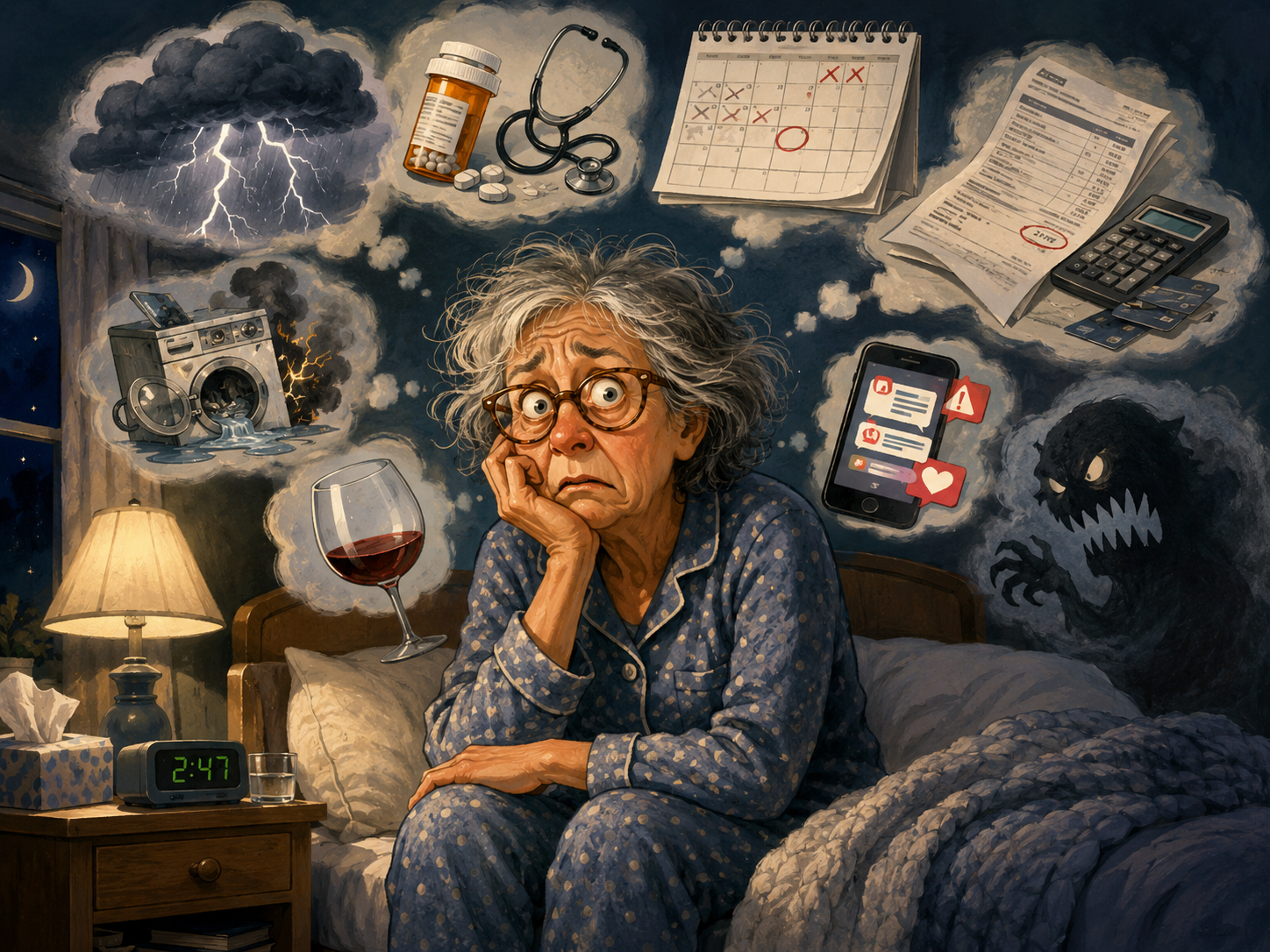
It worries me that I’ve been worrying too much because now I have something else to worry about.
People are remarkably gifted worriers. Squirrels worry about finding their next acorn. That’s about it—unless they’re crossing a road and suddenly see the undercarriage of a car.
Humans are different. We can worry about something that happened yesterday, something that might happen tomorrow and something completely imaginary scheduled for Thursday.
Humans worry professionally.
Sure, there are legitimate things to worry about. War. Cancer. Crime. Inflation. Hurricanes. Whether artificial intelligence will become smarter than humans, assuming it hasn’t already watched television and lowered its expectations.
Those are real concerns, but apparently they’re not enough. We conjure up “what if” worries during slow periods.
A perfectly healthy 70-year-old wakes up Tuesday with a minor pain in his shoulder. At 7:05, he notices it. At 7:10, he wonders if he slept on it wrong. At 7:15, he Googles it.
This is a mistake because Google will suggest at least 10 more things to worry about. WebMD won’t say, “Relax, Larry. You probably just slept funny.”
Instead, you discover that an aching shoulder can be associated with 14 diseases, three syndromes and something last documented in a 1954 issue of National Geographic.
Just as you’re considering an update to your will, the pain disappears and it’s time for lunch.
Senior citizens are particularly susceptible to worrying because, after a certain age, the human body begins making noises. You stand up and something pops. You bend down and something clicks. You get out of bed and discover your left knee has taken the day off.
We understand there’s an expiration date somewhere, so we worry. It’s like spending your entire Florida vacation worrying about the drive home.
Don’t worry. You can have a couple of glasses of wine when you get there.
Wait. Alcohol is bad for you.
Unless moderate amounts are good for you.
For years, red wine was good for the heart. Then experts warned that virtually any amount carries health risks.
This creates a difficult medical decision around 5 p.m. Pouring the second glass may shorten my life. Perhaps not pouring it will do the same.
Hypochondria—often called health anxiety these days—demonstrates the power of imagination. A health worrier doesn’t simply have a headache. He has a headache with dark implications. A normal person lies down. A professional worrier conducts research.
To these topflight worriers, mild sinus pressure can justify a specialist at Johns Hopkins—or at least the nearest urgent care center.
Of course, we don’t restrict worry to our health. We worry about money even when the bills are paid. We worry that the roof will leak when there’s no rain in sight.
Floridians have elevated worrying to an art form.
From June through November, we watch tropical disturbances approximately 4,000 miles away. A television weather report shows a tiny orange blob off Africa.
“Nothing to worry about at this time.”
So we start worrying about “Tropical Disturbance 94L.” The next day, the hurricane is named Kevin, and within hours Publix sells out of bottled water and bagged ice.
We worry about things that probably never will happen. The car could break down. The air conditioner might quit. I could lose my wallet.
Worse yet, what if my editor hates this column?
That last one is entirely possible, so let’s move along.
The wonderful thing about imaginary disasters is that there’s no natural limit. What if my car has a flat tire on Malfunction Junction, my cellphone is dead, and an alligator climbs out of a retention pond while I’m changing the tire?
Before long, a professional worrier can suffer emotional distress from an event that never occurred involving a reptile they never met.
Too often, petty worrying steals from us even as we try to protect ourselves.
It steals Tuesday afternoons and Sunday breakfasts. Vacations. Conversations with our spouses. Time with our children and grandchildren. Quiet evenings when, if we stopped forecasting disasters, we might notice that worry magnifies our fears.
There are things worthy of concern.
If you have persistent or serious symptoms, see a doctor. If a hurricane is approaching, prepare. If you’re drowning in debt, get help. If somebody you love is struggling, pay attention.
Concern that leads to action has value. Worry that merely runs laps around the brain does not. It just creates wrinkles.
We shouldn’t eliminate worry altogether. Our ancestors probably survived because somebody outside the cave said, “Did anybody else hear that?” Those worriers kept families from being eaten by saber-toothed cats and other unpleasant dinner guests.
At 75, I’ve reached the age when I understand that something will eventually get me. That isn’t pessimism. It’s mathematics.
But probably not today.
Today, the roof isn’t leaking. The car started. My shoulder feels fine. There’s food in the refrigerator. People I love are still here. And Hurricane Kevin is somewhere in the Atlantic, hopefully headed for Norway.
That’s a pretty good day.
Maybe the real danger isn’t that something bad will happen tomorrow.
Maybe it’s spending so much time worrying about tomorrow that we miss today.