Someone once told me never to write about weather, not even Florida weather. So here it is, short and sweet.
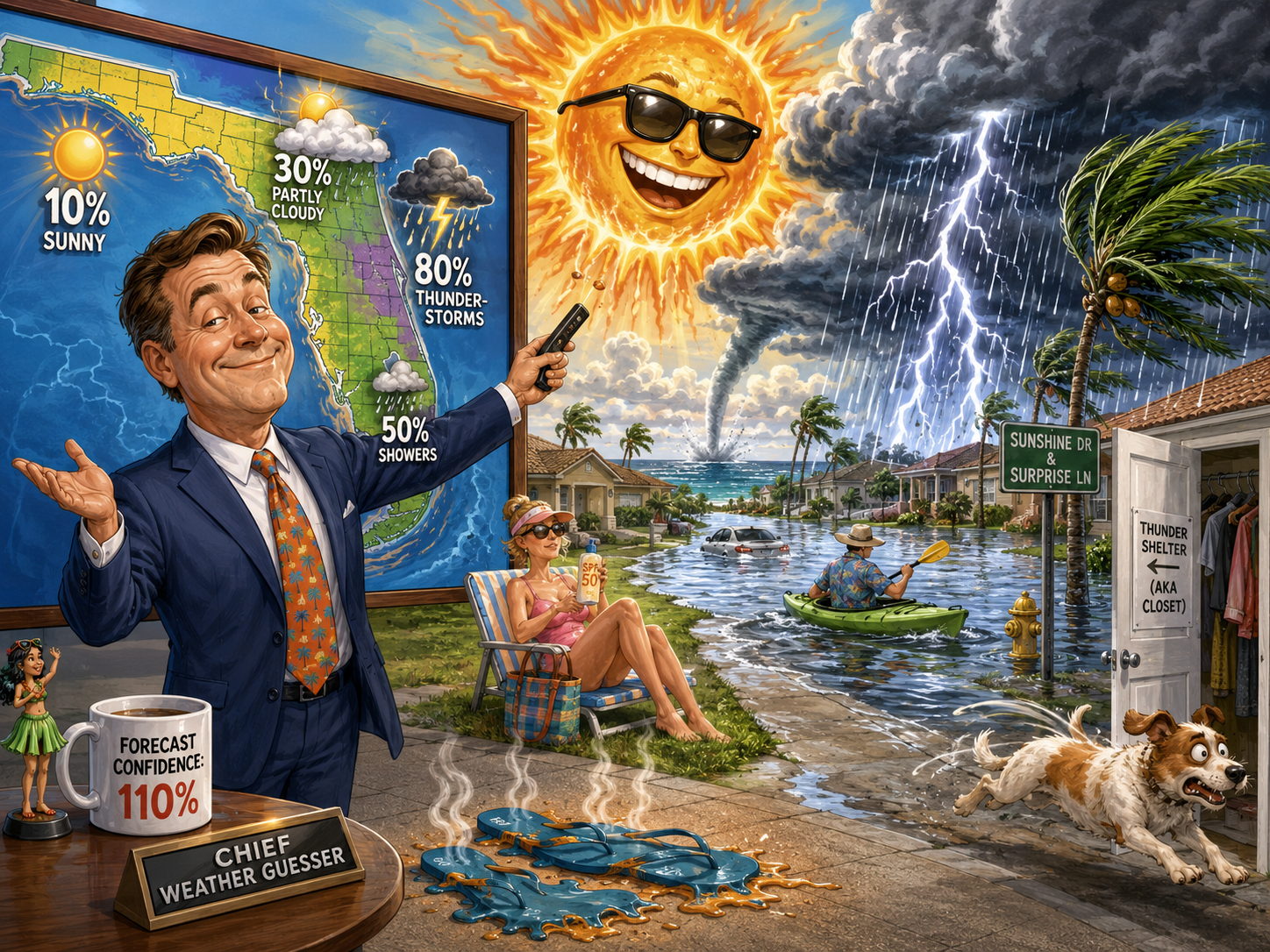
It is so hot between flash floods that when I checked the mail today, my flip-flops became part of the driveway. That is not funny. They cost almost sixteen dollars at Walmart six years ago, and I had finally broken them in.
It is hot. Dangerously hot.
The kind of hot that makes you wonder whether the sun moved closer to Florida because it heard there was no state income tax. By nine in the morning, the steering wheel is a branding iron, the seat belt buckle is a concealed weapon, and the car smells like melted sunglasses.
Thankfully, the heat index is occasionally coaxed below 109 degrees by violent thunderstorms. At the first clap of thunder, our dog Lucy trembles and heads for the nearest closet. Just like that, Florida’s atmosphere switches from oven to dishwasher.
The television meteorologist appears before a map covered with green, yellow, red and purple splotches. Purple apparently means gather your documents and make peace with distant relatives.
Florida meteorologists must have a sense of humor. Almost anyone can predict rain without a studio, a suit or a digital wall the size of a drive-in movie screen.
Only a Florida meteorologist can say, “It should be a quiet afternoon, except for the rotating column of seawater that may or may not sink your boat and tear shingles off your roof.”
Meteorologists have perfected a system that allows them to be right even when they are wrong. It is called the percentage chance of rain.
Suppose the forecast calls for a 30 percent chance of rain. If it rains, the meteorologist was right. Rain was possible. If it does not rain, the meteorologist was still right because there was a 70 percent chance it would not.
This is the only profession where being wrong confirms your accuracy.
I tried using this system around the house.
“There is a 40 percent chance I will mow the lawn today,” I told my wife.
When I did not, I explained that the stronger 60 percent probability had prevailed. I pointed toward the western sky and mentioned unfavorable atmospheric conditions.
She was not impressed.
Apparently, meteorological immunity does not apply to marriage.
Florida forecasts also include phrases designed to sound specific while promising nothing.
“We could see a few scattered showers developing later this afternoon.”
Could see.
A few.
Scattered.
Later.
That sentence contains more escape routes than a Florida developer’s contract.
Then there is “isolated thunderstorms.” Isolated from what? Reality? Common sense? The neighborhood directly across the street?
Florida thunderstorms do not distribute rain equally. One neighborhood receives four inches in twenty minutes. The subdivision across the highway gets three drops and a threatening-looking cloud.
It is not unusual to see someone getting soaked in a driveway while a person across the street applies sunscreen. The flood-weary neighborhood launches kayaks while homeowners two miles away argue about whether they can water on Thursday.
After studying Doppler radar, satellites and computer models, meteorologists announce there is a 50 percent chance of rain.
I can provide the same forecast by looking out the window. It might rain, or it might not—the same two possibilities available before television.
During hurricane season, a tropical disturbance barely coughs off Africa and local weather teams roll up their sleeves.
A spaghetti model appears with twenty possible storm paths. One heads toward Miami. Another aims at Tampa Bay. One curves toward New Orleans. Another squiggly outlier points into the open Atlantic.
The meteorologist studies the lines gravely and says it is “far too early to know where the system may go.”
This does not stop the station from naming its coverage something like Hurricane Death Watch: Florida in the Crosshairs.
For the next ten days, the storm strengthens, weakens, shifts north, shifts south and wobbles.
Nothing good in Florida ever begins with “wobbled.”
By the time the storm turns harmlessly into the Atlantic, every grocery store has sold out of water, batteries and canned tuna. People who never eat canned tuna now own enough to survive a naval blockade.
Then the meteorologist reminds us the storm was always expected to turn.
Of course it was. The turn was clearly visible among the twenty spaghetti lines.
Summer forecasts are less dramatic but just as repetitive: sunshine, building clouds, scattered storms, dangerous lightning, localized flooding and the possibility that someone’s patio furniture will be found three counties away.
The map may show rain covering nearly the entire state, yet the meteorologist insists the storms will be “hit or miss.”
That means either your hibiscus gets watered or your screened porch becomes airborne.
Despite the jokes, Florida meteorologists provide a valuable service. They warn us about lightning, tornadoes, hurricanes, flooding and dangerous heat. Predicting weather on a peninsula surrounded by warm water must be like predicting the behavior of a caffeinated squirrel inside a fireworks tent.
Still, I admire their confidence.
They can point at a storm that failed to arrive and calmly explain that the atmosphere did not behave as the computer models expected.
The atmosphere, apparently, refused to follow instructions.
Tomorrow’s forecast calls for a 60 percent chance of thunderstorms, which means there is a 40 percent chance we will remain dry—unless it rains.
Temperatures will feel somewhere between 105 degrees and the surface of Mercury. Winds will be light except where they are strong. Rainfall will be scattered except where it is widespread.
And the forecast will be completely accurate.
Percentage-wise.