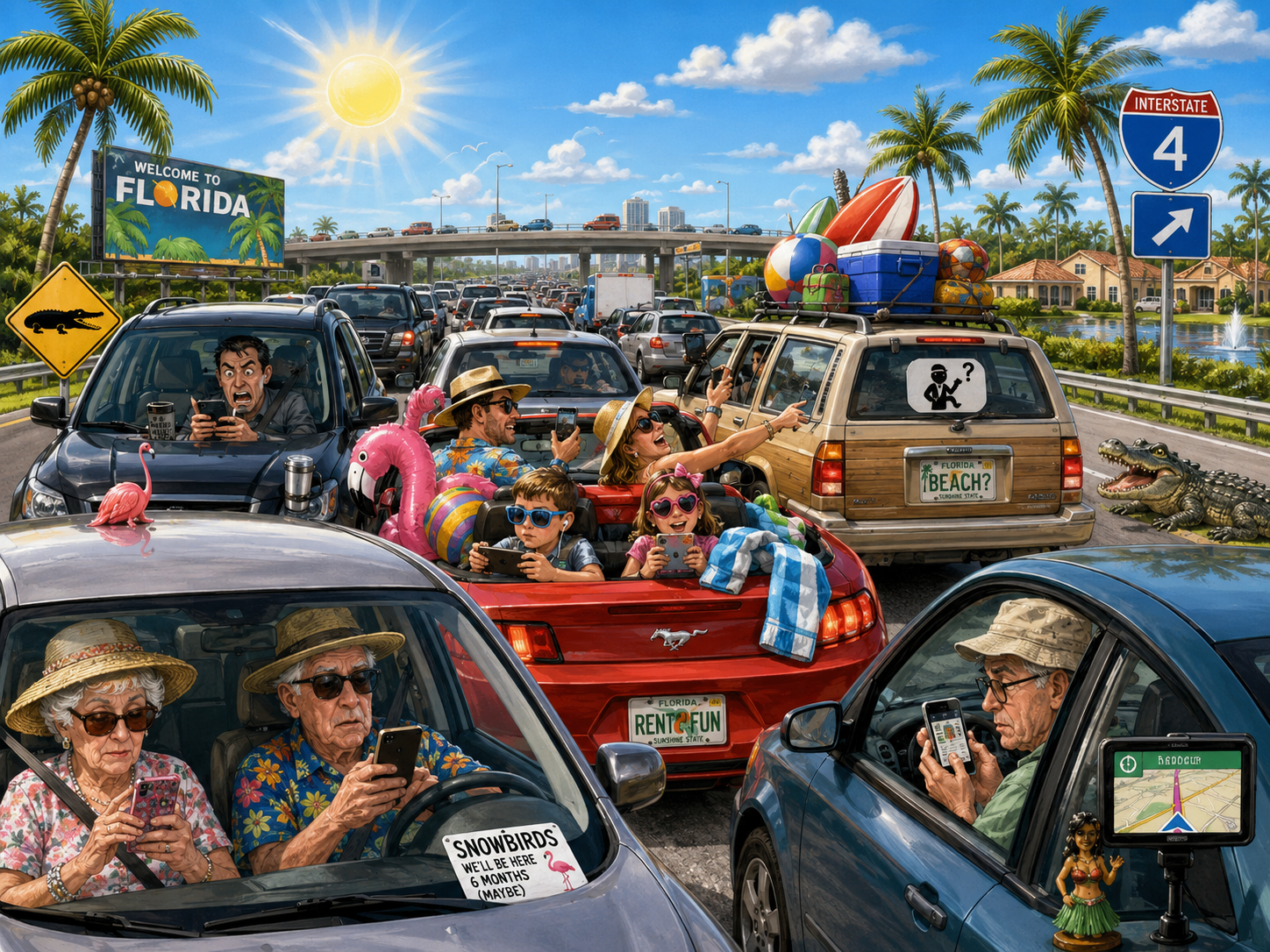
They call them cell phones, which is like calling I-4 a “road.”
Technically true, but wildly incomplete.
The modern cell phone is not a phone. It is a camera, map, mailbox, newspaper, television, shopping mall, bank, flashlight, weather station, argument starter, marriage counselor, marriage destroyer, and emergency device for people who believe they will perish if they go seven minutes without checking Facebook.
In Florida, it is also a tourist compass, hurricane panic machine, serious traffic disruptor, restaurant critic, alligator warning system, sunset recorder, and the reason today’s teenagers suffer nomophobia (the fear of being without a mobile phone) when the teacher says, “Put them away.”
Somewhere along the way, technology morphed Alexander Graham Bell’s electrically transmitted voice machine into a wireless glowing rectangle that can summon a tow truck, order Cuban sandwiches, start a family feud, ruin posture and, on demand, accurately quote the price of tea in China.
Texting or fixating on one’s phone in traffic is where my sympathy begins to thin.
I do not know the number of people killed because somebody was texting “LOL” while cruising through a red light. I’m sure there are studies and grim statistics kept by earnest people wearing safety vests and expressions of great concern.
But I do know this: the number is far north of zero.
A less catastrophic but extremely common sort of phone-related traffic disruption has never been properly studied - the driver who sits at a green light, staring at his phone, while the rest of us grow older behind him or her.
This happens daily. Hourly. Possibly every eight seconds in Tampa Bay area.
The light turns green. Birds sing. A palm frond falls. Somewhere, a child graduates from USF. But there sits the fellow in the SUV, head down, thumbs working like a court stenographer on espresso.
He nor his car budge. The driver in the second car engages in a strange form of signing. Her lips are moving but the windows are up so...
The third car’s driver taps the horn, rolls down his window and shakes his fist while shouting something drowned out by the blare of his horn.
The driver of the fourth car had a bad day at work and really has to pee, so he leans on his horn and mouths a scathing message meant for car number one.
By the time the phone hypnotist looks up, blinks at the green light as if it just arrived from outer space, and rolls forward, the light turns yellow. He makes it through. Nobody else does.
This is not merely annoying. This is theft. He has stolen a full traffic-light cycle from complete strangers.
I am not saying jail him. That seems harsh. Maybe put the phone addict in a roadside booth where he sits while everyone he delayed drives slowly past and shakes their heads, occasionally gesturing an outstretched salute. Repeat offenders deserve harsher punishment – maybe a lengthy lecture by a retired middle school teacher from Tampa holding a clipboard with a whistle hanging from her neck.
Florida already had enough traffic problems before the phone zombies added to the mix.
Take I-4, for example.
I-4 is not so much an interstate as a psychological experiment with orange barrels. It is where tourists, commuters, rental cars, Disney-bound families, construction crews, motorcyclists, snowbirds, and people who learned to drive during the Truman administration merge into one sun-blasted ribbon of mostly stalled traffic.
Now add cell phones.
On I-75, a driver from Dearborn, Michigan, who doesn’t speak English, is barreling along at 80 mph while following GPS directions to an Airbnb on Clearwater Beach. In the next lane, there’s a minivan full of beach-bound children melting down because they aren’t there yet. A pickup driver drifts into another lane while checking football scores. A tourist from Ohio has just learned that in Florida, “exit right” usually means you’re in the wrong lane. Meanwhile, a woman in a rental car is trying to photograph a seafood-buffet billboard so she can enter the address into her GPS at the next stoplight.
All of them are within twelve feet of your front bumper.
Then there is Malfunction Junction, where I-275 and I-4 meet in Tampa, proving civil engineers have a dark sense of humor.
Malfunction Junction is the kind of place where your GPS gives instructions in a nervous voice.
“Stay left to go right. Keep right to go left. In 400 feet, abandon hope.”
You approach it thinking you are a responsible adult with a valid driver’s license. Three minutes later, you are trapped between a semi, a confused tourist, a concrete wall, and a person doing 82 mph while looking down at a phone texting something important like, “Do we need sour cream?”
I know what some readers are thinking: another old guy complaining about technology.
Absolutely. But I am not anti-technology. I’m in favor of indoor plumbing, remote controls, heart stents, garage door openers, air conditioning, and the button that lets me lock my truck from 40 feet away because I forgot whether I locked it six seconds after I locked it.
The cell phone has done wonderful things.
If you are lost, it can guide you home. If your car breaks down, you can call for help. If you fall, you can call 911. If your spouse sends you to Publix for “the good mustard,” you can send a photo from aisle seven and avoid returning home with the wrong mustard, which in some marriages is at least a misdemeanor.
Besides, if you are my age, you remember paper maps. A Florida road trip required one driver, one navigator, three children asking if we were there yet, and a folded map the size of a beach towel. You would pull over, unfold the map across the steering wheel, and discover the town you needed was on the crease where the paper had torn in 1980.
Then came the marital conversation.
“Turn left.”
“Left where?”
“That’s a cow pasture.”
“The map says it’s I-4.”
“That map says Lawton Chiles is governor.”
There was no soothing voice saying, “In one thousand feet, turn right.” There was only your spouse saying, “You missed it,” in a tone suggesting you had missed more than a turn.
So yes, I appreciate phone maps. I appreciate finding a restaurant without asking a gas station clerk who calls every road “just up yonder.” I appreciate weather radar during hurricane season, even though spaghetti models are about as accurate as a 40 percent rain forecast any given day.
When a tropical system forms somewhere off Africa, the phone begins to fret.
First, somebody posts, “Too early to tell.” Then another person posts a map showing the storm hitting Tampa, New Orleans, Nova Scotia, and possibly Portugal. Then everyone goes to Publix for bottled water, batteries, peanut butter, wine, and seventeen things they would never eat under normal circumstances.
The phone helps, sure. But it also turns every retiree with Wi-Fi into a junior meteorologist. By the time the storm reaches the Caribbean, your cousin in Ocala is texting cone projections, your neighbor is posting wind shear analysis, and “StormChaserRick” is yelling into a livestream from a gas station parking lot.
Technology is amazing. It is also exhausting.
Somewhere between useful and addictive, something went wrong. The phone stopped serving us and started training us.
It buzzes, and we obey.
It pings, and we look.
It lights up, and we stop mid-sentence like golden retrievers hearing a cheese wrapper.
A husband can be telling his wife something heartfelt like, “The doctor called,” and she’ll hold up one finger because a friend just posted a photo of her grouper sandwich in Tarpon Springs.
The finger means: whatever you are saying must compete with this tiny rectangle showing me a coupon, a meme, or a funny video of a goose chasing a dog.
The finger is how modern families say, “I love you, but not more than this notification.”
Every family has at least one phone hostage.
You know the one. They sit at dinner with the phone beside the plate like a medical device. They glance at it between bites. They laugh at things nobody else can see. They say “just a second” so often those seconds could be assembled into a second childhood.
In Florida restaurants, food must now be photographed before it is eaten. A waiter sets down fish tacos or fried shrimp, and before anyone can take a bite, somebody says, “Wait.”
The plate is turned. The lemon wedge is moved for better composition. By the time the sandwich is released from its modeling contract, the fries have gone limp and the coleslaw is warmslaw.
Then comes the caption: “So blessed.”
No, you are not blessed. You are eating a cheeseburger in shorts.
Tourists are especially vulnerable to cell phone madness, though I say this with affection because tourism helps keep Florida running and gives locals someone to blame between elections.
A tourist with a phone is a magnificent creature. He can stand in front of the Gulf of Mexico at sunset, one of the most beautiful sights on Earth, and spend the entire moment trying to capture it while his wife says, “Harold, just look at it.”
But Harold cannot look at it. Harold must record it.
The sun sinks. The sky turns orange and pink. Pelicans glide past like prehistoric accountants. Somewhere nearby, a child sees the ocean for the first time.
Harold says, “I can’t get the lighting right.”
This is how the phone steals reality. It convinces us that a moment has not happened unless we have proof for people who were not there.
Snowbirds have their own phone habits.
They arrive every winter with sandals, golf shirts, medical records, and phones full of contacts from three states. They drive slowly, park carefully, and call relatives up north to report the temperature.
“It’s 78 here.”
They do not say this once. They say it repeatedly. They say it to people shoveling driveways in Buffalo, which seems less like conversation and more like emotional vandalism.
Then they take photos of palm trees and send them north with cheerful captions like, “Stay warm!”
This is why some families have inheritance disputes.
Of course, locals are no better. We complain about tourists while checking traffic apps, restaurant reviews, fishing reports, weather radar, and neighborhood gossip pages. This is what phones have done. They took the old rumor mill and gave it a turbocharger.
The worst may be speakerphone people.
These are citizens who believe their private conversations are public programming. They walk through stores broadcasting family drama, medical updates, banking issues, and arguments about who took the leaf blower.
You will be standing in the cereal aisle at Walmart or Publix, minding your own business, when a stranger’s phone shouts, “I TOLD YOU YOUR MOTHER CAN’T STAY WITH US AGAIN.”
Now you are involved. You know too much. You have feelings about the mother. You are unsure about the leaf blower. You may never look at oatmeal the same way.
The phone has also damaged patience. We used to wait in line and simply wait. We looked around. We noticed people. We read magazine covers. We studied the gum selection. We had thoughts.
Now the moment we face fourteen seconds of emptiness, out comes the phone.
Elevator? Phone. Checkout line? Phone. Doctor’s office? Phone. Beach chair? Phone. Red light? Tragically, phone.
We have become a nation terrified of being alone with our own minds. Perhaps this is understandable. Some minds are dangerous neighborhoods. But still, there was value in boredom. Boredom gave us reflection, imagination, prayer, conversation, and occasionally the realization that the person next to us had been waiting to speak.
Now we fill every quiet space with digital confetti.
I am not calling for the end of cell phones. That would be ridiculous. Also, I would get lost by Thursday.
What I am suggesting is a modest return to human command.
The phone should be a tool, not a leash.
It should not decide when we speak, drive, eat, sleep, listen, shop, visit, pray, or look at the person across the table.
We need phone rules, not phones that rule.
No texting while driving. Ever. Not on I-4. Not on I-275. Not on U.S. 19. Not at 20 mph behind a landscaping trailer. Not at 90 mph beside a semi full of oranges. Not while “just checking.” Not while “only replying.” Not while “traffic is slow.” If the message is that important, pull over. If it is not important enough to pull over, it is not important enough to risk turning your car into a three thousand pound battering ram.
No phones at dinner unless someone is on call, waiting for urgent family news, or using it to prove that Uncle Ray really did say manatees are related to elephants.
No speakerphone in public unless you are trapped under something heavy.
No filming entire concerts, graduations, weddings, sunsets, or dolphins. Take one picture. Maybe two. Then put the phone down and attend your own life.
No waving off loved ones unless your phone has just informed you of fire, flood, medical emergency, hurricane landfall, or the arrival of a Publisher’s Clearing House van.
And for the love of Malfunction Junction, when the light turns green, drive safely, but drive.
I know the phone is useful. I know it connects us. I know it can save lives. I know it helps us find the nearest gas station, cheapest hotel, fastest route, urgent care, and whether that thing in the pond is an alligator or merely a log with ambition. The phone connects us - but it can also make us rude, distracted, impatient, dangerous, and mentally absent from the people nearest to us. We carry the whole world in our pockets and sometimes ignore the person sitting next to us.
Maybe the solution is not dramatic. We don’t need a twelve-step program called Glowers Anonymous.
Maybe we should raise a finger to the Instagram notifications instead of little Johnny or our spouse. The phone doesn’t mind.
Look up at the green light. Look up at dinner. Look up at the sunset before photographing it.
Look up before your GPS sends you across three lanes at Malfunction Junction and your obituary says, “He was replying to a text about potato salad.”
The cell phone is brilliant, useful, and powerful. But it is not smarter than we are.
At least, I hope not.
Now excuse me. My phone just buzzed.
I’m sure it’s important.