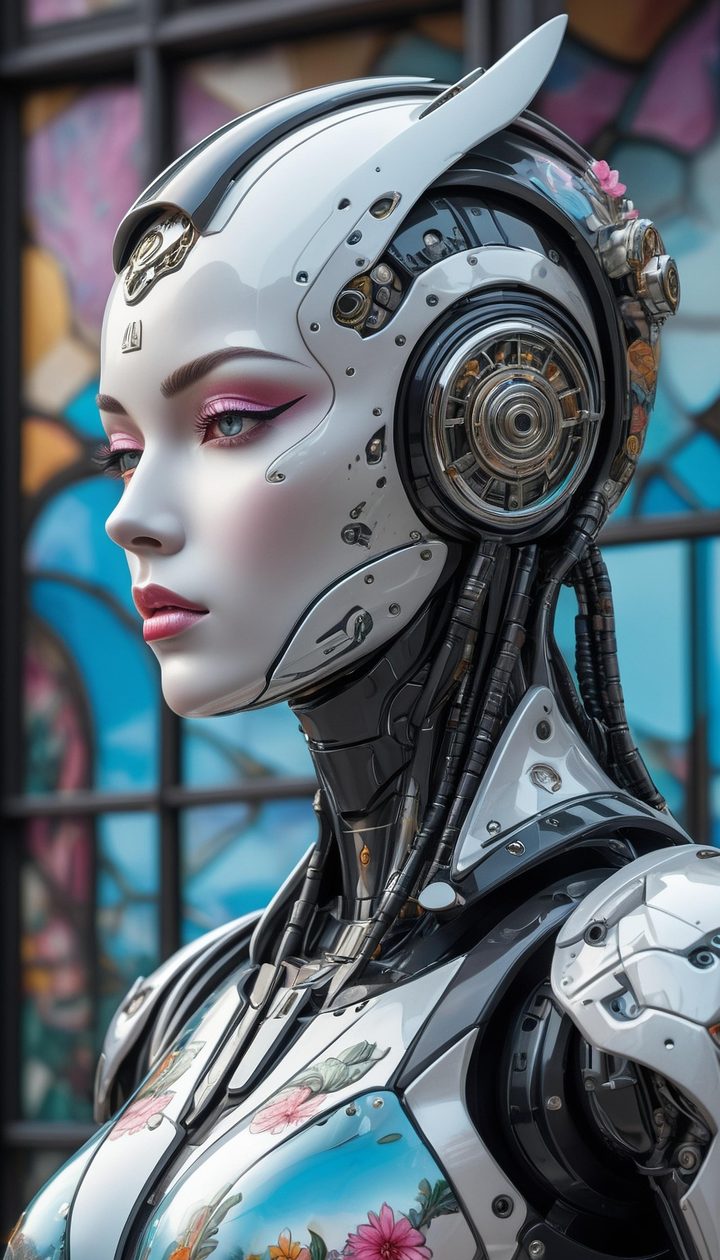
The future has arrived at an upstate New York school district, but for the moment it is standing perfectly still, which is convenient because its legs don’t work.
The Salamanca City Central School District planned to spend nearly $60,000 on “Sally,” a dark-haired, life-size humanoid robot designed to help high school students explore artificial intelligence, robotics and other technology fields. State officials, teachers and residents responded with a question rarely heard at school-board meetings:
“Before we plug her in, exactly who are her relatives?”
Sally’s manufacturer, Realbotix, is connected through corporate ownership to a separate company involved with RealDoll, maker of anatomically ambitious adult companions. Realbotix insists Sally is designed and built as an educational model, not an adult product that was handed a cardigan sweater, a geometry textbook and satellite directions to the faculty lounge.
Still, this was not the family tree parents expected to encounter at curriculum night.
The district envisioned Sally helping students program Arduino boards, understand robotics and troubleshoot technology. Critics seemed to envision an extremely awkward episode of “Welcome Back, Kotter.”
The pilot has been paused while the district works through privacy protections and reassures the community that Sally will not collect recordings, wander the internet or introduce herself during Career Day by discussing the wider interests of the parent company.
Officials say Sally will contain locally stored, approved information and consume about as much electricity as a laptop. That makes her more efficient than the average high school student, who can consume two energy drinks, three bags of chips and the patience of a teacher before second period.
She also will avoid inappropriate discussions involving sex, violence and gambling.
In other words, she is prohibited from commenting on 80% of television news reports and 95.3% of stories on gender in sports.
The teachers union worries Sally could be an early move toward replacing human educators. District officials deny that and stress that teaching depends on relationships between actual people.
They are right. A robot might explain algebra, but it cannot recognize whether a student requesting a 12th bathroom break is going there to smoke, vape, or something more natural. It cannot spend Sunday evening grading 74 nearly identical essays. And it will never master the most important classroom skill: staring silently at two whispering students until they notice, relent, and pay attention for the next five minutes.
Sally’s arrival seems even more interesting when compared with China, where humanoid robots recently competed in the 100-yard dash at the World Humanoid Robot Games in Beijing. One reportedly covered the distance in 8.86 seconds—faster than the recognized human record. Technically, the distance was 100 meters, not 100 yards, but when a machine is moving that fast, nobody should stand near the finish line arguing about the metric system.
The two stories offer a glimpse of the school system of the future.
American students will build robots in science class. The robots will then teach science class. After school, different robots will report to the track, where they will run faster than the students, never forget their uniforms and skip drug testing since their performance-enhancing substance is electricity.
Track coaches will love them.
“Great workout, everybody. Remember to lubricate, charge, and install the latest firmware.”
Nobody will complain about dressing out for gym. Nobody will forge a note from a parent. Nobody will claim a sore hamstring during wind sprints and then recover miraculously when somebody mentions pizza.
Robotic football may be next. Schools could field teams capable of playing every Friday night without suffering concussions, chronic traumatic encephalopathy or unexpected academic issues just before the eligibility deadline.
The quarterback would have a literal rocket arm. The offensive line would be manufactured from an offensive line. When the coach said the defense needed an adjustment, an assistant would open a laptop and download one.
There would still be injuries, but the trainer’s table would contain screwdrivers and WD-40.
“Bad news, Coach. Number 72 blew a circuit.”
“Can he finish the game?”
“Don’t think so, he defaulted to read-only mode.”
The real question is not whether robots can enter schools. They can. The question is what schools want them to do once they arrive.
A robot could introduce cutting-edge technology to students in an isolated community, explain programming and inspire someone to pursue engineering. But communities are entitled to ask who controls the machine, what information it gathers and whether “assistant” might someday quietly become “replacement.”
Those questions should be settled before any school introduces a six-foot electronic colleague, especially one whose corporate genealogy requires an adults-only footnote.
For now, Sally remains sidelined in Salamanca while China’s robots sprint faster than humans. That gives American education a little time to prepare.
First we build robots to help the students.
Then the robots teach the students.
Then they coach the football team.
And eventually, at graduation, the principal shakes a metal hand and announces:
“Congratulations, Class of 2040. Your diplomas have been uploaded. Please exit in an orderly fashion—and try not to get run over by the track team.”