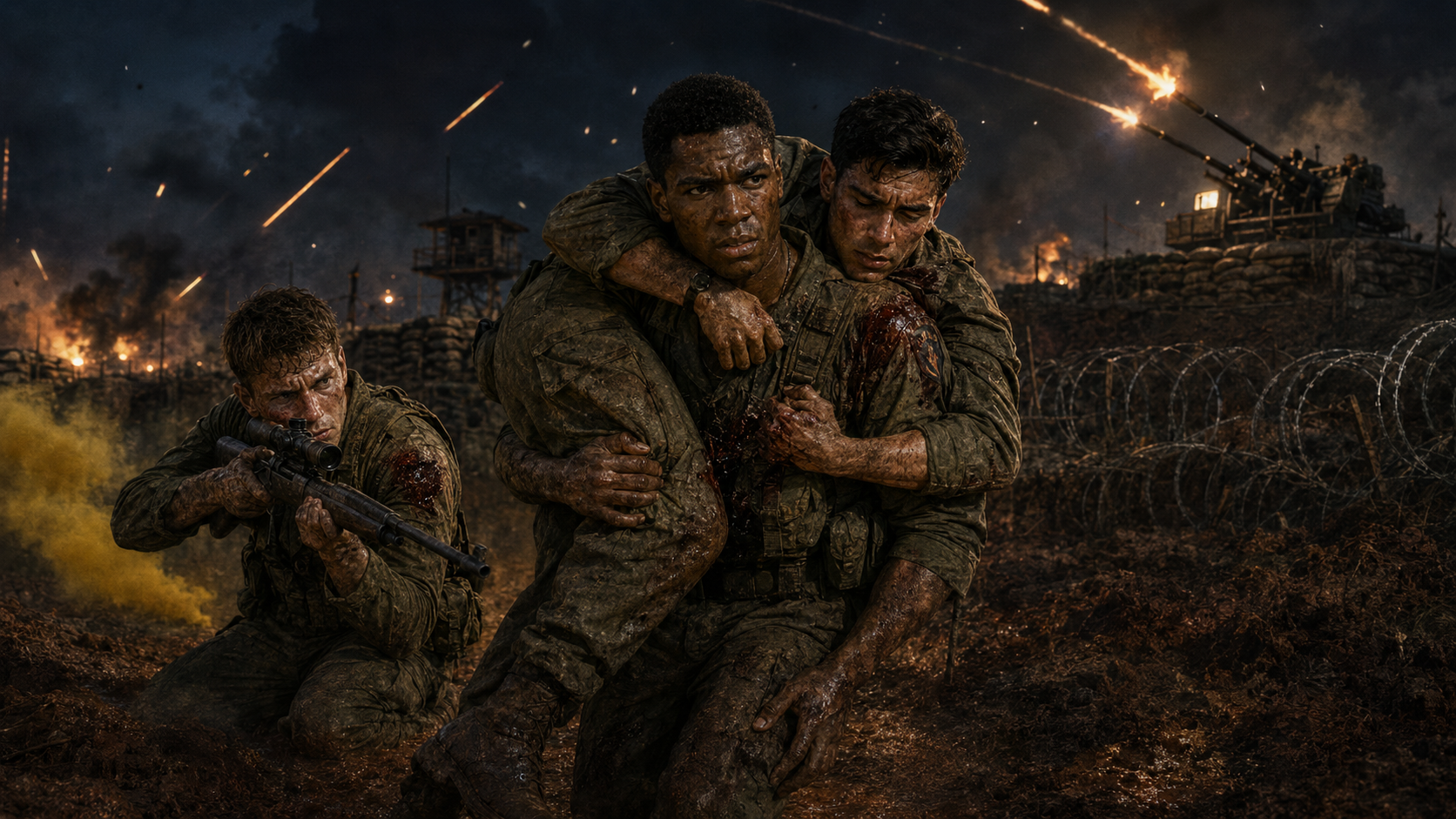
Fergus Flemming stumbled backward as Garin Hooper’s fist whispered past his ear.
Had it landed cleanly, Fergus figured it would have put him on his back in the red dirt, staring up at Vietnam’s white-hot sky and reconsidering every decision that had carried him from a shrimp boat in Louisiana to a besieged Marine base near the Laotian border.
Instead, he lunged forward.
His left caught Garin beneath the eye. His right struck the other Marine’s shoulder. Garin answered with a short hook that snapped Fergus’s head sideways and filled his mouth with the metallic taste of blood.
Someone shouted ”fight.”
Within seconds, a circle of Marines had formed around them near the western perimeter of Khe Sanh Combat Base.
“Finish it, Flemming!”
“Get him, Hooper!”
“Ten dollars on Chicago!”
“Make it twenty on the swamp rat!”
Fergus drove a knee into Garin’s thigh. Garin caught him with an elbow to the ribs. They locked together, boots sliding in the dust, each trying to throw the other down.
It looked like a fight about an insult.
It wasn’t.
The insult had merely lit the fuse.
The real cause was a nineteen-year-old Marine named Tommy Weller, who had died the previous afternoon in a ravine west of the base.
Weller had been the observer assigned to Fergus and Garin’s sniper team. He had stepped from behind a tree after Garin warned him to stay down. An enemy rifle cracked from a distance, then a wet slap in the ravine - Weller folded without making a sound.
Garin blamed Fergus for hesitating.
Fergus blamed Garin for moving too soon and giving away their position.
Neither had said Weller’s name since.
Instead, Garin had made a crack about people in New Orleans being entombed above ground because it was the closest any Cajun would ever get to heaven.
Fergus had answered that walking through South Chicago on a Saturday night was more dangerous than diddy-bopping across a Vietnamese minefield in Ho Chi Minh sandals.
Garin had taken offense.
That had been enough.
Garin pulled Fergus into a headlock.
Fergus drove him backward.
They crashed against a stack of ammunition crates just as a jeep skidded to a stop beside the crowd. A staff sergeant in a sweat-darkened flak jacket rode shotgun. Behind him, a Marine manned an M60 mounted on a pedestal.
“Break it up!”
The crowd scattered with the speed of men who had suddenly remembered appointments elsewhere.
Fergus and Garin remained tangled together.
The staff sergeant climbed out.
“Either you two let go of each other, or we’ll see if my gunner can put a round between your muddy faces without taking a nose off.”
They thought about it for a couple seconds then rolled apart.
Fergus wiped blood from his nose. Garin bent forward, hands on his knees, trying to catch his breath.
“Lieutenant Cabrera wants both of you,” the staff sergeant said. “Bring your rifles.”
That got their attention.
“Now?” Fergus asked.
“No, Flemming. Next Christmas. Move.”
Second Lieutenant Antonio Cabrera had established his command post in a sandbagged bunker close to the western trench line.
At twenty-four, Cabrera seemed ancient to nineteen-year-old Marines. He was six feet, lean, and usually clean-shaven, even when everyone else looked as if they had been dug from the mud. He had been born in Tampa to Cuban parents and spoke English with the flat, patient tone of a man who had learned that raising his voice only encouraged people to become more stupid.
When Fergus and Garin arrived, Cabrera was standing outside the bunker studying a map secured to an ammunition crate with stones.
A radio operator sat nearby, smoking a cigarette and chewing gum.
Cabrera looked up.
“You gentlemen appear to have been struck by enemy artillery.”
Neither answered.
“Unfortunately, I’m told you did this to each other.”
“He started it,” Garin said.
Fergus stared at him. “That is a bald-faced—”
“Shut up,” Cabrera said.
They did.
Cabrera folded the map.
“Corpsman says Weller died before he hit the ground.”
Garin’s jaw tightened.
Fergus looked toward the airstrip.
A C-123 transport was making its approach through low haze. The aircraft came in steep and fast, engines roaring as it dropped toward the runway. Men waited beside forklifts and trucks, ready to unload it before enemy gunners found the range.
Cabrera watched Fergus.
“You think Hooper caused Weller’s death?”
“I think he moved before I was ready.”
“You were ready,” Garin said. “You had the shooter in your scope.”
“I had movement in the trees. That ain’t the same thing.”
“He fired because you waited.”
“And Weller stood up because you told us to move.”
Cabrera stepped between them.
“What killed Weller was a North Vietnamese soldier with a rifle. You two are helping him by tearing this team apart.”
Neither Marine responded.
Cabrera pointed west.
“Yesterday’s patrol reported fresh fortifications near the creek. Intelligence believes the NVA is moving recoilless rifles or mortars into position. We have a listening post on a low finger six hundred meters outside the wire. The field telephone went dead an hour ago.”
“You want us to check it?” Fergus asked.
“I want to know whether the wire was cut accidentally, cut by the enemy, or cut because the Marines at that post are dead.”
The C-123 touched down. Mortar rounds began falling somewhere beyond the eastern side of the base. Ground crews raced toward the aircraft while it continued rolling.
Cabrera looked at his watch.
“We leave at nineteen hundred. You two are coming with me.”
“Sir,” Garin said, “putting us together might not be the best idea.”
“I’m not putting you together. The Marine Corps did that months ago. I’m merely refusing to let either of you run away from it.”
Cabrera picked up his helmet.
“You’re both nineteen. Hooper, you’re a Black kid from South Chicago. Flemming, you’re a white Cajun who grew up on shrimp boats in Louisiana. I’m the son of two Cubans who escaped Castro and now live in Hialeah My father drives a 1958 Nash because he had one like it before Castro’s henchmen confiscated it.”
Fergus offered a sad smile.
Cabrera continued.
“The North Vietnamese don’t care where your mothers delivered you. They don’t care what color you are. They care whether you can shoot, whether you can move, and whether you’ll go back for the man beside you.”
Garin rubbed his bruised ribs.
“With respect, sir, is there a point coming?”
“The point is that tonight I need two snipers. Not two boneheads pointing fingers and carrying guilt that don’t belong to them.”
Cabrera returned his attention to the map.
“Get checked by the corpsman. Clean your weapons. Be here at eighteen thirty.”
Fergus and Garin turned to leave.
“Flemming.”
Fergus stopped.
“If Hooper steps on a mine tonight, what will you do?”
“Check whether it’s booby-trapped before I pull him off.”
“Hooper?”
“If Flemming gets bit by a pit viper, he’s on his own. I’m not sucking venom out of any Cajun.”
Cabrera almost smiled.
“That is the nearest thing to teamwork I’ve heard from either of you.”
They left through a breach in the western wire shortly after dark.
Cabrera led.
Behind him came Lance Corporal Paul Mills, carrying the radio. Fergus followed with his M40 rifle cradled across his chest. Garin brought up the rear with his own rifle and enough ammunition to make his equipment feel twice as heavy as it had inside the perimeter.
Clouds covered the moon.
The night smelled of wet earth, crushed vegetation, aviation fuel, and the faint human sewage odor that drifted beyond every field military contingent.
They moved without talking.
Behind them, Khe Sanh was never entirely dark. Shielded lamps glowed inside bunkers. Flares hung over distant hills. Artillery pieces fired at irregular intervals, illuminating the low clouds with orange flashes.
The patrol crossed the first line of concertina wire, passed through the marked lane in the minefield, and descended into elephant grass.
Fergus could no longer see the base.
The feeling came immediately—the primitive certainty that the darkness contained eyes.
Cabrera raised a fist.
Everyone stopped.
A branch clicked somewhere ahead.
Fergus lowered himself to one knee and stared through the trees. Sweat crawled beneath his flak jacket despite the cooler night air.
Nothing moved.
Cabrera signaled them forward.
They reached the listening post twenty minutes later.
The position consisted of a shallow fighting hole covered with branches and leaves. A field telephone rested against one wall. The handset hung by its cord.
The two Marines assigned to the post were gone.
There was no blood.
No discarded equipment.
No sign of a struggle.
Mills checked the telephone.
“Dead, sir.”
Garin crouched beside the communication wire running from the rear of the post.
“Here.”
The wire had been cut cleanly.
Not broken.
Cut.
Cabrera studied the ground with a red-filtered flashlight shielded by his hand.
Several boot prints marked the soft soil. The impressions were narrower than American jungle boots.
Fergus pointed toward the creek.
More prints.
“At least six,” he whispered.
“Moving east,” Garin said.
Toward Khe Sanh.
Cabrera extinguished the light.
They listened.
At first Fergus heard only insects and the distant thump of artillery.
Then another sound emerged.
Metal touching metal.
A murmured voice.
The scrape of equipment through brush.
The sounds came from the western slope, beyond the creek.
Cabrera led them toward higher ground overlooking the water. They crawled the final thirty yards on their stomachs.
Below them, dark figures moved between the trees.
Dozens of them.
North Vietnamese soldiers were filing east in disciplined silence. Some carried rifles. Others carried ammunition boxes, mortar tubes, rockets, coils of wire, and long poles supporting heavy loads.
The column disappeared into the jungle north of the listening post.
Garin pressed his face close to the ground.
“That ain’t just a patrol.”
Cabrera took the radio handset from Mills.
“Razor Six, this is Razor Two-Six. Urgent traffic.”
Static answered.
Mills adjusted the antenna.
Cabrera tried again.
“Razor Six, Razor Two-Six.”
A weak voice emerged.
“Two-Six, send it.”
“Large enemy movement west of the perimeter. Grid follows.”
Cabrera read the coordinates from his map. As he spoke, Fergus watched the column through his scope.
An NVA soldier stopped.
The man turned his head toward the ridge.
Fergus held his breath.
The soldier stared directly toward their position.
Another man joined him.
The second soldier carried a machine gun.
Fergus whispered, “We’ve been made.”
Cabrera keyed the radio.
“Razor Six, fire mission. Enemy troops in the open. I say again—”
A green flare rose from the enemy column.
It burst above the trees.
The hillside became a world of green light, black shadows, and startled faces.
“Move!” Cabrera shouted.
The machine gun opened fire.
Rounds snapped through the leaves. Dirt kicked against Fergus’s cheek. Mills rolled behind a tree and transmitted the coordinates while Cabrera fired his M16 downhill.
Fergus found the machine gunner in his scope.
The man was kneeling behind a fallen log. Muzzle flashes strobed in front of him.
Fergus fired.
The rifle bucked.
The machine gun continued.
“Missed!” Garin shouted.
“I know!”
Fergus worked the bolt.
A round struck the tree above him and showered his neck with bark. He shifted the crosshairs, controlled his breathing, and fired again.
The machine gun stopped.
Then rifles opened fire from the creek bed.
Garin fired downhill, worked his bolt, and fired again.
“More coming from the north!”
Cabrera grabbed Mills by the shoulder.
“Tell them danger close. Repeat the coordinates.”
Mills pressed the handset to his ear.
“Razor Six, fire mission—”
A rifle cracked from the darkness.
Mills jerked backward.
He remained upright for a moment, still holding the radio, then collapsed across Cabrera’s legs.
Cabrera pulled him behind the tree.
One look was enough.
Mills had been hit through the neck.
Cabrera took the radio.
“Fall back east!”
Fergus grabbed Mills beneath one arm.
Cabrera stopped him.
“He’s gone.”
“We can’t leave him.”
“We’re not. But we can’t carry him while they’re on top of us.”
Garin fired into the creek bed.
“We got movement left!”
Cabrera shoved the radio at him.
“Take it.”
The first friendly artillery rounds screamed overhead.
Explosions erupted on the western slope, throwing dirt, timber, and men into the air. The concussion struck Fergus’s chest like a giant hand.
“Walk it west!” Cabrera shouted into the radio. “Two hundred meters west!”
The patrol withdrew east through the trees.
Fergus moved ten yards, dropped behind cover, and aimed west while Garin and Cabrera passed him. Then Garin covered while Fergus moved.
It was the same leapfrog method they had practiced dozens of times.
It had never felt so slow.
Enemy rounds cut through the vegetation.
The North Vietnamese were spreading out to flank them from the north. Others moved through the elephant grass to the south, trying to get between the patrol and the perimeter.
Fergus glimpsed a soldier thirty yards away and fired too quickly.
The round vanished into darkness.
The enemy soldier dropped behind a tree and returned fire.
A bullet struck Fergus’s rifle stock, splitting the wood near his left hand.
Fergus rolled downslope.
Garin fired at the tree.
“Move, Cajun!”
Fergus scrambled toward him.
They reached the abandoned listening post together.
Cabrera was kneeling beside the telephone wire.
“We follow this home,” he said. “It takes us to the western gate.”
Garin looked back.
“What about Mills?”
Cabrera’s expression hardened.
“When we have enough men and enough guns, we come back.”
The earth suddenly lifted beneath them.
A deep explosion rolled across the valley, far larger than the artillery impacts behind them. A column of fire rose from Khe Sanh.
For one frozen second, the three Marines watched.
The base ammunition dump had been hit.
Secondary explosions followed, one after another, hurling burning debris hundreds of feet into the air. Tracer rounds climbed from North Vietnamese positions surrounding the plateau. Mortars and rockets began falling across the combat base.
The entire horizon flashed.
The siege had begun.
“My God,” Garin whispered.
Cabrera seized the radio.
“Razor Six, Razor Two-Six. We are outside the western wire with enemy forces between us and the perimeter.”
Only static answered.
Cabrera struck the handset against his helmet.
“Razor Six.”
Nothing.
The three men began following the wire east.
They had covered perhaps a hundred yards when Fergus saw the field telephone wire rise from the ground.
It had been looped around a tree.
A second strand ran away from it, south into the elephant grass.
“Stop.”
Cabrera froze.
Fergus pointed.
“That ain’t ours.”
Garin crawled closer.
The second wire was thinner and newer. It continued through the grass toward the base.
“Command wire,” he said.
“To what?” Cabrera asked.
Fergus followed its direction.
The western perimeter lay somewhere beyond the darkness. The wire likely ended at an explosive charge placed near the concertina or at a culvert beneath the approach lane.
The NVA had not merely cut the telephone line.
They had used it as a guide.
Cabrera keyed the radio again.
No answer.
“We have to find the charge,” he said.
Garin stared at him.
“We have half the NVA behind us. If that wire leads to the gate, they’ll blow a hole through it and us when their assault starts.
“Then we warn the base,” said Cabrera.
“With what?”
The radio hissed uselessly.
Cabrera pointed at Fergus.
“You stay on the original line. Find the gate.”
Then he pointed at Garin.
“You’re with me.”
Fergus grabbed Cabrera’s sleeve.
“Sir, splitting up is a bad idea.”
“So is allowing a sapper team to open our perimeter.”
“I’ll follow the command wire,” Fergus said. “You two take the radio home.”
Cabrera studied him.
“Why you?”
“Because Hooper’s prettier.”
Garin shook his head. “That’s the first stupid thing you’ve said that I believe.”
A mortar round exploded somewhere to the east.
Another landed closer.
Cabrera made his decision.
“We stay together.”
They moved south along the command wire.
The grass rose above their shoulders. Visibility shrank to several feet. Artillery flashes turned the blades silver, then black.
Fergus followed the wire by touch. It ended beneath a clump of brush.
Cabrera carefully pulled the vegetation aside.
A large explosive charge had been packed into a drainage culvert. Wires ran from it westward toward the enemy position.
Garin whistled softly.
“That goes off, us and the gate disappear.”
Fergus examined the charge.
“Can we disarm it?”
“Engineers can,” Cabrera said. “We’re leaving it alone.”
He attached a strip of white cloth to a nearby branch so they could find it again.
A burst of automatic fire came from the west.
Rounds whipped over the grass.
The North Vietnamese had found them.
“Back to the line!” Cabrera shouted.
They ran crouched through the grass.
An enemy soldier rose in front of Garin, no more than fifteen feet away. Both men hesitated in mutual surprise.
Garin swung his rifle.
The NVA soldier fired first.
The shot went wide.
Garin drove the rifle barrel into the man’s face. They fell together. The enemy soldier grabbed Garin’s throat with one hand while reaching for a knife with the other.
Fergus could not fire without hitting Garin.
He dropped his M40, rushed forward, and kicked the knife away.
The NVA soldier rolled free and reached for his rifle.
Cabrera fired twice.
The man collapsed.
“Move!”
Fergus grabbed his rifle as more silhouettes appeared in the tall grass.
Garin snatched the dead soldier’s rifle and fired a short burst toward them. The unfamiliar weapon climbed in his hands, rounds snapping high.
“It’s got more kick than my uncle’s mule!”
“Your uncle got a mule in Chicago?” Fergus shouted.
“He lives in Mississippi!”
“I knew you was hiding something!”
They reached the original telephone line.
Behind them, enemy soldiers shouted to one another.
Ahead, the sky above Khe Sanh pulsed orange.
The three Marines followed the wire east at a fast trot.
The ground sloped into a shallow drainage ditch. Cabrera jumped first.
A rifle fired from the northern tree line.
Cabrera spun and fell into the ditch.
“Lieutenant!”
Garin slid beside him.
Blood spread across Cabrera’s flak jacket near the right armpit. Each breath produced a wet, sucking sound.
“Chest wound,” Garin said.
Fergus aimed toward the trees.
“Sniper.”
The rifle cracked again.
A round struck the lip of the ditch inches from his face.
Fergus dropped.
“Can you see him?” Garin asked.
“No.”
Cabrera struggled to breathe.
Garin tore open the lieutenant’s jacket. The bullet had entered high on the right side. Blood bubbled from the wound.
“Sucking chest wound.”
“Seal it,” Fergus said.
“With what?”
Fergus pulled the plastic wrapper from a field dressing. Garin pressed it over the hole and secured three sides with tape from Cabrera’s gear, leaving the bottom open.
Cabrera coughed.
“Exit wound?”
Garin rolled him partially over.
“None I can find.”
“Then it’s still in there.”
“No shit, Doctor Flemming.”
The enemy sniper fired again.
This time Fergus saw the flash.
High in a tree seventy yards north.
The man had tied himself among the branches, using foliage for concealment.
Fergus settled the rifle on the edge of the ditch.
The scope showed leaves, branches, and darkness.
Nothing that looked human.
A flash erupted.
The round hit Garin’s helmet, tearing away the cloth cover and knocking him flat.
“Garin!”
“I’m good!”
“You sure?”
“I’ good, asshole! You got to take him out.”
Fergus kept watching the tree.
The sniper had fired three times from nearly the same position. He would know Fergus had seen the flash. He might relocate, or he might wait for Fergus to expose himself.
Fergus removed his helmet.
He raised it slowly above the ditch on the barrel of Cabrera’s rifle.
The sniper fired.
The helmet spun away.
At the same instant, Fergus caught the movement in his scope—a shoulder shifting behind the trunk.
He fired.
Leaves trembled.
A rifle fell from the tree.
The sniper’s body followed seconds later, striking branches on the way down.
Garin looked at Fergus.
“You sure took your sweet time.”
“I was waiting for you to get shot in the head, Chicago.”
Cabrera tried to sit.
“Stop talking and get me to the wire before I bleed out.”
Garin lifted him beneath the arms. Fergus took his legs.
They carried the lieutenant east through the ditch.
Enemy fire followed them.
The ditch offered protection from the north but left them exposed to soldiers moving through the grass behind them. Fergus had to stop repeatedly, set Cabrera down, and fire west while Garin covered the lieutenant.
Their progress became a brutal pattern.
Carry.
Drop.
Shoot.
Move.
Each time they lifted Cabrera, he made a sound through clenched teeth. Each time they put him down, his breathing sounded worse.
The radio suddenly came alive.
“Two-Six, Razor Six. Two-Six, respond.”
Garin grabbed the handset.
“Razor Six, this is Two-Six Actual’s patrol. We have one urgent casualty and enemy troops closing from the west.”
“Identify.”
“Lance Corporal Hooper. Lieutenant Cabrera is hit. Mills is KIA at the listening post.”
A pause followed.
“Your location?”
Garin looked toward Fergus.
Fergus pointed east.
“We’re in the drainage ditch approximately one hundred fifty meters west of the gate.”
The voice on the radio changed.
“Hooper, we have enemy movement all across your sector. Dusters are engaging west of the wire. Mark your position.”
Garin searched his equipment.
“Smoke.”
Fergus handed him a grenade.
“Yellow.”
Garin pulled the pin and threw it onto the southern bank.
Yellow smoke billowed upward.
The wind pushed it east—toward the base.
“Razor Six, yellow smoke.”
“We see yellow. Confirm friendlies west of smoke.”
“Negative! Friendlies north and slightly west of smoke. I say again, do not fire directly north of yellow.”
The twin cannons of an M42 Duster opened from inside the perimeter.
The sound was unlike rifle or machine-gun fire. It came as heavy, rhythmic punches that shook the ground. Forty-millimeter rounds passed overhead and exploded along the western tree line.
Trees disintegrated.
The enemy fire weakened.
Garin grinned despite the blood running from beneath his helmet.
“Those Dusters playin’ my song!
Fergus looked toward the base.
The yellow smoke had revealed the drainage ditch to everyone.
Including the North Vietnamese.
Men began moving through the grass south of them, trying to reach the ditch before the Marines reached the wire.
“Lift him,” Fergus said.
They carried Cabrera another fifty yards.
The outer concertina came into view. So did the gate, less than a hundred yards away.
Between the patrol and the perimeter lay open red earth churned by countless bullets and explosions.
There would be no cover.
Marines inside the trench fired west. An M60 machine gun hammered from a bunker. Tracers whizzed over the ditch.
A voice called through a bullhorn.
“Two-Six! Stay in the ditch! We’ll cover you!”
Cabrera clawed at Garin’s sleeve.
“The charge.”
“What?”
“The culvert. Tell them about the charge.”
Garin raised the radio.
“Razor Six, enemy demolition charge in the drainage culvert south of the gate. Marked with white cloth. Do not send anyone into that culvert until engineers clear it.”
The reply came immediately.
“Understood.”
An explosion struck behind them.
Fergus felt himself lifted and thrown forward.
He landed on his stomach, ears ringing.
For several seconds, he could not remember where he was.
Then Garin was above him, shouting.
Fergus saw his mouth moving but heard nothing except a high metallic tone.
He pushed himself upright.
Pain tore through his left shoulder.
His sleeve was wet with blood.
Garin examined the wound.
“Round went through.”
“Can I move my arm?”
“You’re moving it.”
“So quit admiring me.”
Cabrera lay several feet away, barely conscious.
North Vietnamese soldiers entered the ditch behind them.
Fergus counted at least five.
Garin fired the captured rifle until it clicked empty. He threw it aside and drew his pistol.
Fergus tried to shoulder the M40.
Pain made his vision blur.
He rested the rifle against the ditch wall instead.
The first enemy soldier appeared in his scope.
Fergus fired.
The man fell.
He worked the bolt with his right hand.
The second soldier dropped into the ditch.
Garin shot him twice with the pistol.
A grenade landed in the dirt between them.
For a fraction of a second, no one moved.
Then Garin instinctively grabbed it and threw it back.
It exploded above the ditch.
Fragments hissed through the grass.
“Move!” Garin shouted.
He hauled Cabrera upright.
Fergus tried to help, but his left arm was mostly limp.
Garin bent, pulled Cabrera across his shoulders, and stood beneath the lieutenant’s weight.
“You can’t carry him that far,” Fergus said.
“Then shoot anybody who says I can’t.”
Garin climbed out of the ditch.
The open ground waited between them and the wire.
Marines in the trench increased their fire.
The Duster shifted aim farther west. Its cannons tore into the grass behind the patrol, penning the NVA down.
Garin staggered toward the gate with Cabrera across his shoulders.
Fergus followed, holding his rifle awkwardly against his right side.
Fifty yards.
A round struck the dirt near his boot.
Forty yards.
Cabrera slipped from Garin’s shoulder.
Garin caught him before he hit the ground.
Thirty yards.
An NVA soldier rose from a shell crater to their left.
Fergus saw him turning with an RPG launcher.
The man was not aiming at them.
He was aiming through the gate at the Duster.
Fergus dropped to one knee.
His left shoulder screamed as he forced the rifle into position.
The crosshairs wandered across the enemy soldier’s chest.
Fergus could not steady them.
He exhaled.
The crosshairs slowed.
The RPG gunner shifted his stance and raised the launcher.
Fergus squeezed the trigger.
The gunner fell backward into the crater.
The rocket fired as he fell, streaking across the ground and exploding against the outer concertina.
The blast flattened Fergus.
Garin disappeared in smoke.
Fergus rolled onto his back.
He saw sky.
Black smoke.
Burning wire.
He tasted dirt and blood.
Garin emerged from the smoke without Cabrera.
For one confused moment, Fergus thought the lieutenant had been killed.
Garin grabbed the straps of Fergus’s flak jacket.
“What are you doing?” Fergus asked.
“Going back for a Cajun.”
“You got Cabrera in?”
“Marines at the gate took him.”
Garin began dragging Fergus.
“I can walk.”
“Then walk.”
Fergus tried.
His legs folded.
Garin pulled Fergus’s good arm over his shoulders and lifted him.
They staggered toward the perimeter together.
Rounds struck the ground behind them.
A Marine inside the wire shouted for them to hurry.
What? They think we’re sightseeing here,” Garin shouted breathlessly to nobody in particular.
The Duster opened fire again.
The world behind Fergus vanished beneath smoke and flying earth.
Hands reached through the gate.
Marines grabbed Fergus and Garin, dragging both men through the opening as perimeter guards prepared to close it.
A corpsman knelt beside Fergus.
“Where are you hit?”
“Shoulder.”
“Anybody else?”
“Lieutenant Cabrera. Chest wound.”
“We have him.”
“Mills is still out there.”
The corpsman cut Fergus’s sleeve.
“We’ll get him. Captain’s already putting three patrols together, ‘bout fifty bad ass grunts, maybe more.”
Fergus looked for Garin.
He found him sitting against the trench wall, staring at his empty hands. Blood ran down one side of his face from where the bullet had struck his helmet.
“You hit?” Fergus asked.
Garin shook his head.
“What about your head?”
“Ain’t nothing important in there.”
Fergus leaned against the wall beside him.
Beyond the perimeter, artillery continued falling. Rockets passed overhead. Machine guns hammered from the trench line. The western sky glowed from burning ammunition and fuel.
Khe Sanh seemed to be coming apart one explosion at a time.
Fergus looked toward the gate.
“We left Mills.”
Garin stared into the smoke.
“We’ll bring him home.”
“Cabrera?”
“He’s alive.”
“You sure?”
“I heard him insult a corpsman.”
Fergus nodded.
“That’s a good sign.”
For several moments, neither spoke.
Then Garin held out his fist.
Fergus looked at it.
“What’s that?”
“A dap.”
“I know what it is.”
“Then don’t leave me hanging.”
Fergus touched his bruised knuckles against Garin’s.
The contact was brief.
It was enough.
The siege lasted through the remaining weeks of winter and into the spring.
Fergus and Garin returned to duty before either was fully healed. There men and too much ground to watch.
They operated together outside the perimeter when patrols were possible and from bunkers when they were not. They learned to distinguish outgoing artillery from incoming by sound. They learned to sleep beneath explosions and awaken during silence. They learned that fear could live inside a man for weeks without killing him, provided he kept feeding it small jobs to do.
Watch the tree line.
Count the rounds.
Check the wire.
Keep the rifle clean.
Wake your partner.
Mills’s body was recovered two days after the opening attack.
Fergus and Garin carried him through the western gate.
Neither spoke while they did it.
Lieutenant Cabrera survived after surgery at Phu Bai. The bullet had missed his heart but damaged his lung. Before returning home to “the world” he talked a UH‑1 “Huey” chopper pilot into joining a “dustoff” mission to a besieged Khason weeks later. Cabrera, thinner and moving with the aid of a cane, was as feisty as ever.
After inspecting the repaired drainage culvert, he looked up Fergus and Garin.
They were sitting outside a hooch cleaning their rifles.
Cabrera stopped in front of them.
“You two look terrible.”
“Thank you, sir,” Garin said.
“I understand you ignored several sensible opportunities to abandon me.”
Fergus examined his rifle bolt.
“Hooper insisted on carrying you. I advised against it.”
“That’s a damn lie,” Garin said. “He cried the whole way. Kept saying, ‘Save the lieutenant. Save that beautiful Cuban officer.’”
Cabrera nodded solemnly.
“That sounds accurate.”
He lowered himself onto an ammunition crate.
For a while, the three men watched aircraft circle the runway.
The hills beyond Khe Sanh were green again. From a distance, the battlefield looked almost untouched. Only the shattered trees and exposed red earth told the truth.
Cabrera rubbed his chest.
“I heard you’re both leaving.”
“Four days and a wake up ‘til DEROS,” Fergus said.
“Freedom bird,” Garin added.
“What will you do when you get home?”
“Work on my uncle’s shrimp boat,” Fergus said. “Maybe buy one of my own someday.”
Cabrera looked at Garin.
“Chicago?”
“College, maybe. My mother says if I survive Vietnam and don’t use the G.I. Bill, she’ll kill me herself.”
“A reasonable woman.”
Garin smiled.
Cabrera rose carefully.
“My father still has that Nash.”
“We figured the Viet Cong got it,” Fergus said.
“No enemy is that desperate.”
Cabrera started away, then stopped.
“Weller and Mills would have been proud of you.”
The humor left both young Marines.
Cabrera tapped his cane against the red earth.
“Remember them longer than you remember this place.”
“Yes, sir,” Garin said.
Cabrera walked toward the command bunker.
Fergus continued cleaning his rifle.
After a moment, Garin said, “I’ve been thinking.”
“That’s dangerous.”
“Maybe you didn’t hesitate that day Weller got hit.”
Fergus kept his eyes on the weapon.
“Maybe you didn’t move too soon.”
Neither apology was complete.
Both were understood.
Garin held out his fist.
Fergus met it with his own.
Black and white.
Chicago and Louisiana.
City pavement and Cajun water.
All the things that had seemed large inside the wire became small beyond it.
Like Cabrera, the wire had never cared where the troops came from. The wire was there to protect them all, as best it could.