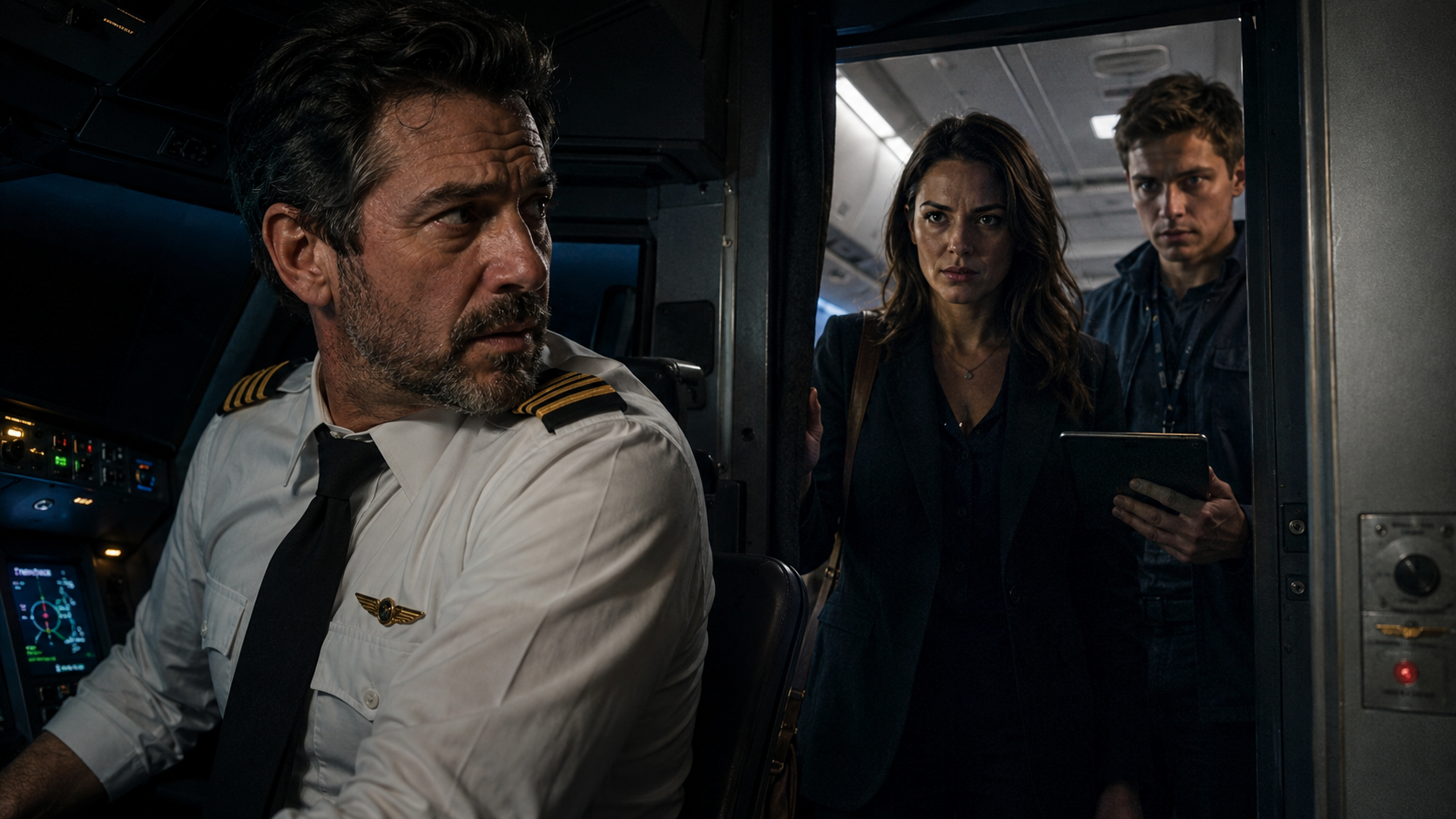
Captain Ben Rivers first saw the dead man at thirty-eight thousand feet.
The man stood outside the flight deck door in a mechanic’s blue shirt, one hand braced against the bulkhead as Flight 417 trembled around him. Smoke had begun to smear the windows on the right side of the Boeing, and somewhere behind the cockpit wall, three hundred passengers were learning that panic could spread faster than fire.
Lexi Sloan stood beside him, pale but steady.
“Captain,” she said, “this man says he knows why the fire bottles won’t fire.”
Ben stared at him.
The man was thinner than Ben remembered. A chemical burn striped his neck. One eye had swollen half-shut, and his right hand shook as if it had been badly shocked. But it was him.
Silas Hart.
Layla’s pool guy.
The pool guy Layla had just confessed to killing.
For one long second, Ben heard nothing but the scrape of his own breathing inside the headset. Then the aircraft shuddered again and the right wing sagged as if something enormous had grabbed it from below.
First Officer Lucas Ramirez snapped, “Captain?”
Ben forced himself back into the cockpit.
“Get him in here.”
Lexi pushed Silas through the door and locked it behind them. Then she looked at Ben in a way he had never seen before. Not frightened. Not guilty. Not in love. Judging.
Silas lifted both hands.
“I know what she told you,” he said. “Most of it is true.”
Ben nearly came out of the seat.
Lucas grabbed his shoulder. “Not now, Cap.”
Not now.
Those two words had become the whole architecture of Ben Rivers’ life.
Not now when Annalise coughed blood into a hotel towel in Denver and told him not to cancel his flight because, really, she felt better.
Not now when grief met him at every gate and in every mirror.
Not now when Layla first touched his wrist at a blackjack table in Las Vegas and looked at him as though he were not a widower but a man who had simply misplaced his future.
Not now when Lexi Sloan laughed beside him in a London rainstorm two weeks ago and he forgot, for one ruined night, that betrayal always comes dressed as rescue.
And certainly not now, with Engine Two burning, the suppression system dead, the radios unreliable, passengers screaming, and the woman he had married sitting somewhere in Los Angeles expecting the Pacific Ocean to swallow him whole.
Ben kept his hands on the yoke.
“What did you do to my airplane?” he asked.
Silas looked past him, toward the burning wing.
“I gave your wife exactly what she paid for,” he said. “Then she tried to kill me so I couldn’t undo it.”
Seventeen hours earlier, Ben had stood in the marble foyer of his house while Layla Rivers flung a Hermes purse at his head.
It missed him and struck one of the carved Bocote doors with a slap that sounded almost human.
“You think I’m stupid?” she said.
Ben had spent enough years flying through weather to recognize pressure building invisibly. Layla had always been emotional, then jealous, then suspicious. Lately she had become theatrical in the way hurricanes were theatrical: all performance until the roof came off.
“I think you’re tired,” Ben said.
That was the wrong answer.
Layla laughed once, sharp and empty. “How generous of you. Captain Saint Benjamin diagnoses the poor crazy wife.”
“Don’t do this.”
“Do what? Notice things? Notice that your pretty little flight attendant transfers to your route and suddenly you’re shaving twice a day?”
Ben looked away.
That was enough for her.
“Oh,” she said softly. “There it is.”
He should have lied better. Pilots were trained for emergencies, not marriages. He could read wind shear in the bones of an airplane but could not navigate the silence between a husband and wife when both already knew the truth.
“Layla,” he said.
She stepped closer. Expensive perfume, black silk blouse, diamond bracelet, eyes bright with humiliation. When Ben met her, she had been working as a casino host, gliding between men with money and men pretending to have money. She could read desperation across a room. It was her talent, her weapon, and maybe the only childhood inheritance worth keeping.
Her father had gambled away rent. Her stepmother had hidden food. Men had promised Layla safety, then taken what safety she had. By thirty, she had decided never again to be poor, never again to be helpless, never again to be the woman waiting for someone else to choose her.
Then she married a pilot with a dead wife, a house in Los Angeles, and grief so deep it looked like loyalty.
“What’s her name again?” Layla asked. “Lexi?”
Ben said nothing.
Layla smiled as if she had solved a puzzle.
“You know what’s funny? I knew before you did.”
That stung because it was true.
He had not planned London. He had not planned the rain, or the delayed crew shuttle, or Lexi beside him beneath a hotel awning at midnight. He had not planned to tell her about Annalise, about the nursery he once painted yellow, about the bicycles never bought and the dog never adopted. He had not planned to kiss her.
But afterward, when he returned home, Layla had looked at him once and known.
“I’m going to file when I get back,” Ben said.
For a moment the rage drained out of Layla’s face and left something younger behind. A terrified girl in a borrowed mansion.
Then the woman returned.
“No,” she said. “You’re going to Honolulu tomorrow. Then you’re coming home and remembering who owns what.”
Ben picked up his flight bag.
“Listen to yourself.”
“No, Ben. You listen.” She moved to the staircase, one hand sliding along the rail. “You and that woman are about to learn something I learned early.”
“What’s that?”
“Exits are for people who can afford them.”
At 10:14 the next morning, Flight 417 departed Los Angeles for Honolulu.
At 12:03, a vibration moved through the aircraft like a cough inside a giant chest.
At 12:04, Engine Two exploded.
The blast tore away a section of cowling and sent a black ribbon of smoke twisting past the windows. Passengers on the right side saw flame and immediately became strangers to themselves. A businessman prayed into a phone with no signal. A woman in 23A screamed until she fainted. A retired schoolteacher slapped a drunk man who tried to open a miniature whiskey bottle with his teeth.
In the cockpit, Ben and Lucas moved with the cold rhythm of training.
Engine shutdown.
Fuel valve closed.
Fire handle pulled.
Bottle one discharged.
Nothing.
Bottle two.
Nothing.
Detection loop dead.
Backup circuit unresponsive.
Radio transmission chopped into static.
Lucas looked at him. “That’s impossible.”
“Impossible is a word for people on the ground,” Ben said.
But his stomach had gone hollow.
Lexi entered minutes later, face composed, eyes alive with dread.
“Passengers need something from us,” she said.
“Tell them we have an engine fire, we’ve shut the engine down, and we are preparing for emergency procedures.”
“Are we landing in water?”
Ben glanced at the flames.
“We’re preparing for the possibility.”
Her mouth tightened, but she nodded.
Then she leaned down, close enough that Lucas and Alison Williams in the jump seat could hear every word.
“Ben, there’s something else.”
“Not now.”
“I need to say it.”
He turned.
Lexi Sloan was forty-one, which in airline years meant she had spent half a lifetime learning how people behaved when the sky betrayed them. She was not the fragile romantic Layla imagined. She had raised two younger brothers after her mother disappeared into pills. She had married once, badly, and left with a suitcase, a restraining order, and a conviction that love was not worth dying stupidly for.
London had frightened her not because it was meaningless, but because it was not.
“I love you,” she said. “That’s not a demand. It’s just something true.”
Ben closed his eyes for half a second.
“Go do your job,” he said.
She did.
Then Ben’s satellite phone vibrated.
He almost ignored it. Then he saw no name, only a number. Any call might be a chance to pass coordinates.
“Rivers.”
Layla’s voice came through light and delighted.
“Hello, Birdman.”
Ben’s hand tightened.
No one called him that except Layla, and she only did it when she wanted to make flying sound childish.
“I’m busy.”
“I know. I’m watching. The news says your airline lost contact.”
Ben signaled Alison to record. She took the phone, tapped the screen, and held it near the console.
“Layla, listen very carefully. We have an emergency. I need you to write down coordinates.”
She laughed.
“Oh, Ben. Always giving orders. Even on your last day.”
Lucas looked over.
Ben felt something cold settle along his spine.
“What did you do?”
“I didn’t do anything,” she said. “I hired someone.”
The cockpit seemed to shrink.
“Who?”
“You remember Silas. The pool guy. Quiet. Sweaty. Looked at me as if I were Christmas morning.”
“Layla.”
“He wasn’t just a pool guy. Isn’t that funny? He was military. Explosives. Electronics. Dishonorably discharged, naturally, but one does what one can with the help.”
Alison whispered, “My God.”
Ben kept his voice level. “Where is Silas?”
There was a pause.
“I imagine he is wherever dead men go after drinking poisoned whiskey.”
Ben stopped breathing.
Layla sighed theatrically. “You should have seen him, Ben. So proud of himself. He thought we were going to run away together. Men are adorable when they mistake use for affection.”
Lucas mouthed, Keep her talking.
“What exactly did he do?” Ben asked.
“Oh, darling, I didn’t ask for a lecture. He said the engine would burn. He said the fire system wouldn’t work. He said the radios might not either, depending on whether his little gadget survived the blast. I told him I didn’t care about details. Details are for employees.”
“There are three hundred people on this aircraft.”
“Yes,” Layla said, and for the first time her voice changed.
Not guilt. Not regret.
Calculation.
“That’s why no one will suspect me. Tragedies like that are too big for wives.”
Ben heard, distantly, someone screaming in the cabin.
“You’re insane.”
“No, Ben. I am finally practical.”
He ended the call before she could say another word.
For five seconds nobody spoke.
Then Lucas said, “We’ve been sabotaged by your wife’s pool guy.”
Ben looked at the burning wing.
“Apparently not by a good one.”
That was when Lexi knocked on the cockpit door and brought in the dead man.
Silas Hart had been a Marine once, though not the kind who told stories in bars. He had the look of a man built by punishment: wiry, watchful, eyes trained to expect impact. His left hand shook unless he pinned it to his thigh.
He told it quickly because the wing was burning.
Layla had found him through a contractor. She flirted first, then confided. Ben was abusive, she said. Ben was dangerous. Ben had another woman and powerful friends and would leave her with nothing. Silas had not believed all of it. But he had believed enough, especially after she showed him bruises he later realized she had made herself.
“She knew what to say,” Silas said. “Knew where to press.”
“Save the confession,” Lucas snapped. “Can you stop the fire?”
“Yes.”
“How?”
Silas swallowed.
“I built in a manual defeat. I wasn’t going to murder a plane full of people without a way to reverse it.”
Ben stared at him.
“You were willing to murder me?”
Silas looked at him, and there was no excuse in his face.
“At first,” he said.
Lexi’s eyes flashed. “At first?”
Silas turned toward her. “Then she poisoned me.”
He had suspected Layla would betray him because everyone betrayed everyone eventually. That was the one philosophy combat and poverty had left him. So when she poured the whiskey, he noticed how carefully she held the glass. He pretended to drink. Later, when she went to shower, he poured half the bottle into a potted palm and replaced enough with pool chemicals to burn his throat and make him vomit convincingly.
“She wanted a dead body,” Silas said. “I gave her a performance.”
“And got on this plane?” Ben said.
“I bought a seat under a false name after I couldn’t get near the maintenance bay. I planned to get to your crew before takeoff and undo the work. Security tightened after a delay. Then the doors closed.”
Lucas laughed once, bitterly. “Wonderful. Our terrorist had scheduling problems.”
Silas looked toward the right wing.
“If I don’t get below, everyone dies.”
Ben wanted to hit him. He wanted five impossible minutes on solid ground with the man who had turned his aircraft into a coffin. Instead, he pointed toward the cockpit door.
“Lucas goes with you.”
Silas shook his head. “He won’t know what he’s looking at.”
“He knows aircraft systems.”
“He doesn’t know my sin.”
The words silenced the cockpit.
Lexi said, “I’ll go.”
“No,” Ben said.
“I can fit where Lucas can’t, and passengers will let me move through the cabin faster. If he tries anything, I’ll bury a crash axe in his skull.”
Silas looked at her with something like respect.
Ben looked at Lexi. In London, he had imagined she might save him from loneliness. Now she stood in a burning aircraft offering to crawl beneath the floor with a saboteur.
He had never felt smaller.
“Take Lucas,” Ben said.
Lexi did not argue.
They left the cockpit and moved into the forward galley. Smoke had begun to push through the ventilation system in thin gray threads. The aircraft vibrated with a deeper note now, a bad note, the kind pilots feel in their teeth.
Below the galley hatch, the avionics bay was cramped, hot, and loud. Lucas went first, then Silas. Lexi crouched above them with a flashlight and the crash axe tucked along her leg.
Silas moved with awful competence. He removed a panel, reached past a nest of wires, and found a device no larger than a deck of cards.
Lucas swore. “That’s yours?”
“One of them.”
“One of them?”
Silas turned toward Lucas.
“She asked for certainty.”
In the cabin, certainty had become impossible.
Lexi moved aft. She touched shoulders, corrected life vests, took bottles away from men who had decided intoxication was courage. She knelt beside a little girl whose oxygen mask had tangled in her hair.
“What’s your name, sweetheart?”
“Maya.”
“I’m Lexi. I need you to help your mom listen to me.”
“Are we going to die?”
Lexi had answered that question a hundred softer ways in her career. Today she chose the truth with its sharp edges sanded down.
“Not if we do our jobs.”
“What’s my job?”
Lexi tightened the girl’s life vest.
“Stay brave for ten minutes.”
Maya nodded as if accepting a sacred assignment.
When Lexi returned to the galley, Silas was bleeding from one hand.
Lucas shouted up, “He killed the bypass. We need fire bottle pressure.”
In the cockpit, Ben watched the fire warning flicker.
“Bottle one armed,” Alison said.
Ben’s finger hovered above the switch.
Over the interphone, Silas said, “Wait.”
Ben froze.
Lucas barked, “What now?”
Silas’s voice came through ragged. “She changed something.”
Ben closed his eyes.
Layla.
Of course.
“What does that mean?” Ben asked.
“It means the second circuit isn’t mine.”
Lucas said, “There’s another device?”
Silas was breathing hard.
“She must have hired somebody else to make sure I didn’t get sentimental.”
That was the moment Ben understood his wife better than he ever had in marriage. Layla had trusted no one. Not Ben. Not Silas. Not even the man she hired to kill Ben. She had built betrayal into betrayal, a nesting doll of ruin.
“What happens if we discharge?” Ben asked.
Silas did not answer quickly enough.
Lucas did.
“It could ignite fuel vapor in the wing root.”
Ben stared out at the flames.
The ocean below glittered with impossible beauty.
“Can you remove it?”
Silas laughed softly. “Sure. If your first officer has three hands and no desire to grow old.”
Lucas looked up at Lexi.
“Get out of here.”
“No.”
“Lexi.”
“No.”
Silas said, “I need the axe.”
Lexi handed it down.
“What are you doing?” Lucas asked.
“Making a smaller mistake.”
Metal screamed. Sparks spat. The aircraft bucked.
In the cockpit, alarms began stacking one over another.
Hydraulic pressure.
Cabin pressure.
Fire.
Master caution.
Ben’s world became gauges, muscle memory, prayer.
“Alison, wind.”
“Two-six-zero at eighteen. Swells maybe four to six. Captain, we’re low.”
“I know.”
“Do we ditch?”
Ben looked again at the wing.
A pilot does not decide to put an airliner into the ocean. The sky takes away everything else until the sea is the last surface left.
He reached for the interphone.
“Lexi, prepare the cabin.”
Her answer came immediately.
“Already doing it.”
He almost smiled.
Of course she was.
Then Silas screamed.
The sound tore through the interphone, raw and animal. Lucas shouted something unintelligible. A second later, smoke burst up from the galley hatch. Lexi coughed, dropped to her knees, and grabbed for Lucas as he emerged.
Silas did not follow.
“Where is he?” she shouted.
Lucas coughed black into his sleeve. “Pinned.”
Lexi looked down into the hatch.
Silas lay twisted below, one leg trapped beneath a bent bracket, face gray with pain. In his burned hand he held the severed device.
He lifted it slightly.
“Tell your captain,” he rasped, “I cleaned the pool.”
Lexi reached for him.
He shook his head.
“Bottle now.”
She ran.
In the cockpit, the right wing was flame.
Ben heard Lexi over the interphone.
“Do it now!”
Ben discharged bottle one.
For a heartbeat, nothing happened.
Then white chemical vapor burst across Engine Two in a hard, beautiful cloud. Flame fought it, flared blue, then yellow, then collapsed into smoke.
Alison whispered, “Fire warning out.”
No one cheered.
Ben kept the aircraft descending until the airspeed steadied and the wing held. The Triple-7 flew wounded, lopsided, and alive.
Behind him, Lucas dragged Silas from the avionics bay. The pool guy was unconscious, burned, and still breathing.
Flight 417 returned to Los Angeles under escort.
The landing was ugly enough to make television commentators call it miraculous and pilots call it adequate. When the aircraft stopped, emergency crews flooded the runway. Passengers stumbled down slides into sunlight, weeping, laughing, kissing asphalt, calling people they had not planned to forgive.
Maya, the little girl from 32C, handed Lexi a plastic toy airplane.
“You did your job,” Maya said.
Lexi closed her hand around it.
“So did you.”
Ben was the last to leave the cockpit.
On the tarmac, Lucas hugged him hard enough to hurt. Alison cried openly, embarrassed by it and then too exhausted to care. Paramedics carried Silas away beneath an oxygen mask.
Lexi found Ben under the burned wing, staring at the engine.
“About what I said in the cockpit,” she said.
He turned.
“I meant it,” Lexi said.
Ben tried to speak, but there were too many reporters beyond the fence, too many ambulances, too many people alive who should not have been.
“But I won’t be your life raft,” she said.
He looked down.
“You think that’s what I want?”
“I think Annalise died and Layla found the empty place before you did. I think I walked into it because I have empty places of my own.”
“That sounds like goodbye.”
“It sounds like honesty.”
She placed Maya’s plastic airplane in his hand.
“Keep this,” she said. “To remind you what people trust you with.”
Then she walked toward the ambulance line and did not look back.
Ben’s phone rang again.
This time it was airline security.
“Captain Rivers,” a man said, “where is your wife?”
Layla Rivers had dressed for widowhood in a black silk robe.
She had chosen inexpensive mascara because expensive mascara did not run convincingly. She had sliced an onion and dabbed beneath both eyes. On the marble table lay insurance documents, a revised will, and a handwritten list titled Calls to Make.
She had practiced three versions of grief.
The first was stunned silence.
The second was collapse.
The third was rage at God, which she suspected would be useful with reporters.
When the doorbell rang, she checked her face in the mirror and saw perfection: ruined, beautiful, wealthy grief.
At the door stood a square man with airline credentials and a woman in a navy suit.
“Mrs. Rivers?” the man said. “Toni Cappitani, airline security. This is Detective Erika Milan, LAPD.”
Layla brought a hand to her throat.
“Is it Ben?”
Detective Milan stepped forward.
“Layla Rivers, you are under arrest for conspiracy to commit murder, attempted mass murder, and the attempted murder of Silas Hart.”
Layla stared at her.
“Silas Hart is dead.”
“No,” said a voice from the driveway.
Ben Rivers stepped out of the unmarked car.
Layla stopped moving.
The officers held her upright, but something inside her seemed to slide loose and fall.
“No,” she said.
Ben walked toward her slowly.
“I’m very much alive. So is Silas. So is everyone else.”
Layla made a sound no one on the portico would forget.
“You’re dead,” she whispered.
“No.”
“This is a trick.”
“It’s over, Layla.”
The frightened child inside her surfaced then, not as grief, but as fury. She lunged so hard the officers nearly lost their grip.
“This is mine!” she screamed. “All of this is mine!”
Ben studied her face and tried to find the woman from the blackjack table, the one who had touched his wrist as if she could feel his pulse and his sorrow. He found only a locked room with a terrified child inside, breaking furniture in the dark.
Detective Milan guided Layla toward the patrol car.
As they lowered her inside, she kept screaming that everyone was dead.
Ben returned home after midnight.
The house was quiet. Too large. Too polished. A museum to bad choices.
He walked through the foyer, past the table where Layla had arranged her widowhood, and out to the swimming pool.
The pool lights were off. Leaves floated across the surface. On the far side, Silas’s long aluminum cleaning pole leaned against the wall where he had left it days earlier.
Ben stood there with Maya’s plastic airplane in his hand.
He thought of Annalise and the yellow nursery. He thought of Lexi walking away because love, at its best, sometimes knows when not to rescue. He thought of Silas Hart, who had done an unforgivable thing and then crawled through smoke to undo it.
At last Ben walked to the controls and turned on the underwater lights.
The pool brightened slowly, from black to blue.
Beneath the leaves, beneath the small ripples and the reflected moon, the water was clear all the way down.
For the first time in years, Ben could see the bottom.