Bonnie Graves had cut hair in five counties, three retirement communities, two funeral homes, and one county jail, but she had never seen fear sit so openly on a man’s face as it did on Wilfred Stone’s.
He occupied seat 18B of Pacifica Flight 417 like a man strapped to an electric chair.
His knees were pressed together. His hands gripped the armrests. His eyes kept darting to the small oval window beside Bonnie as if the Pacific Ocean were going to rise up, tap the glass, and ask to come in.
“You all right?” Bonnie asked.
Wilfred swallowed. He was somewhere in his late forties, big through the shoulders, soft in the middle, with a trimmed mustache and the pale, damp look of a man regretting every decision that had brought him here.
“My cousin told me flying is safer than driving,” he said.
“It is.”
“He also told me there’s a toilet up front that sucks people right out of the plane.”
Bonnie smiled despite herself. “That part’s less true.”
Wilfred leaned closer. “Less true?”
Bonnie had been a stylist long enough to recognize the kinds of lies people needed. The woman who wanted bangs after a divorce. The man who said his wife loved the comb-over. The grandmother who claimed she didn’t care if chemo took the rest. Wilfred did not need facts. He needed tone.
“You’re going to be fine,” she said.
The jet dipped slightly.
Wilfred made a sound like a kicked accordion.
Up in the cockpit, Captain Seth Ferman rested one hand on the controls and watched a wall of Pacific weather build on the horizon. He was fifty-two, silver-haired, steady, and bored by danger in the way only a good pilot could afford to be. To his right sat Jacob Johnson, twenty-eight, too clean-shaven and too eager not to be obvious about it.
Behind them, in the jump seat, Sara Fisk studied the navigation display with a frown.
Commercial jets did not carry navigators anymore, at least not in the old sense, but Flight 417 was testing a supplemental long-range oceanic navigation package for Pacifica Air. Sara was the company’s specialist, sharp-eyed and narrow-faced, with blonde hair and the manner of a woman who had never once lost her keys.
“Storm line’s moving faster than forecast,” she said.
Seth nodded. “How much room?”
“Enough if we bend south now. Not enough if we wait ten minutes.”
Jacob looked at the radar. “Dispatch gave us the northern track.”
“Dispatch isn’t sitting in this windshield,” Seth said.
He clicked the radio and requested deviation.
In seat 4C, Omar Abbas heard the captain’s voice change through the overhead speakers. He did not understand every word, but he understood enough.
He turned his head slightly toward the man beside him.
Mastafa’s face remained blank.
Omar hated that about him. Mastafa was built like a butcher, wide neck, heavy arms, eyes like wet stones. Omar believed in causes, speeches, consequences. Mastafa believed in impact. That made him useful and dangerous.
The flight attendant, Lydia Chen, came down the aisle collecting cups and wrappers. She smiled at Omar.
“Anything else for you, sir?”
Omar smiled back.
“Not yet,” he said.
At 34,000 feet, the first shudder passed through the aircraft like a warning from God.
The cabin lights flickered once. A baby cried. Plastic cups rattled. Somewhere behind Bonnie, a man laughed too loudly, as people sometimes did when the air reminded them they were not in charge.
Wilfred whispered, “That normal?”
“Completely,” Bonnie said, though she had no idea.
The seatbelt sign chimed.
Captain Ferman’s voice came over the speakers, warm and calm.
“Folks, we’re going to ask everyone to remain seated while we work around some rough air ahead. Nothing to be concerned about. We’ll have you back in smooth skies shortly.”
Sara Fisk was already recalculating.
“Southwest heading buys us twenty minutes,” she said. “But there’s a gap forming here.”
Seth looked. “That gap looks ugly.”
“It is. But everything else is uglier.”
Jacob shifted in his seat. “Fuel?”
“We’re fine,” Seth said.
Sara did not answer immediately.
Seth glanced back.
“We’re fine,” she said, but she said it like a woman filing a protest.
In row 4, Omar stood.
Lydia saw him immediately.
“Sir, the seatbelt sign is on.”
Omar reached under his jacket.
Lydia’s smile died before the weapon appeared.
Mastafa rose behind him, turning with a second weapon in his hand, sweeping it across first class.
“Sit down!” Omar shouted.
The cabin changed instantly. The sound did not grow louder so much as sharper. Gasps became screams. A tray dropped. Someone prayed. Someone else said, “No, no, no,” in the small broken voice of a child.
Bonnie felt Wilfred’s hand clamp around her wrist.
“What’s happening?” he whispered.
She did not answer because she knew, and knowing made the air leave her chest.
Omar grabbed Lydia by the arm and pulled her in front of him.
“Cockpit,” he said. “Now.”
Lydia’s face had gone white, but her voice held. “I can’t open it.”
“You will.”
“I can call them.”
“Then call.”
Mastafa shoved a passenger back into his seat hard enough to crack the man’s head against the window.
“Eyes down!” he barked. “Hands where we see them!”
In 18B, Wilfred shut his eyes.
Bonnie looked at him, then at the aisle, then toward first class. Her purse was under the seat. Inside were hair clips, a comb, small scissors, and a metal tail comb she had forgotten to take out before boarding. Useless things. Tiny things.
Still, her hand moved slowly toward the bag.
Mastafa saw the movement from twelve rows away.
“You!” he shouted.
Bonnie froze.
He came down the aisle with terrible speed, stepping over feet and bags, the weapon low but ready.
Wilfred opened his eyes and saw him coming.
“I didn’t do anything,” Wilfred blurted.
Mastafa reached them, grabbed Bonnie’s purse, and dumped it into the aisle. Lipstick, wallet, gum, tissues, combs, clips, little scissors. He picked up the scissors and smiled.
“A hair woman,” he said.
Bonnie forced herself to meet his eyes. “Stylist.”
Mastafa slapped Wilfred across the face with the back of his hand.
“Quiet.”
Wilfred’s head snapped sideways. His eyes watered. Bonnie felt something in herself move—not bravery exactly, but anger, old and clean.
Up front, Lydia’s call chimed in the cockpit.
Seth answered. “Go ahead.”
Lydia’s voice was thin. “Captain, I need you to open the door.”
Seth did not move.
Jacob looked at him.
Sara’s fingers froze over the navigation keypad.
Seth pressed the intercom. “Lydia, are you under duress?”
There was a pause. Then Omar’s voice came through.
“Open the door or she dies in front of your passengers.”
Seth closed his eyes once.
Jacob whispered, “Captain—”
“No,” Seth said.
Omar’s voice hardened. “You have ten seconds.”
Sara unbuckled and stood.
“Seth,” she said, “if they start killing passengers, the door won’t matter.”
Seth’s jaw tightened.
He knew the procedures. He knew the locked door was the line. He also knew procedures were written by people sitting safely on the ground.
Omar began counting.
When he reached four, Sara touched Seth’s shoulder.
“I can stand behind the bulkhead,” she said quietly. “If it opens, I’ll be out of sight.”
Seth looked at Jacob. “Transmit emergency.”
Jacob’s hands moved fast.
Seth unlocked the cockpit door.
The world broke open.
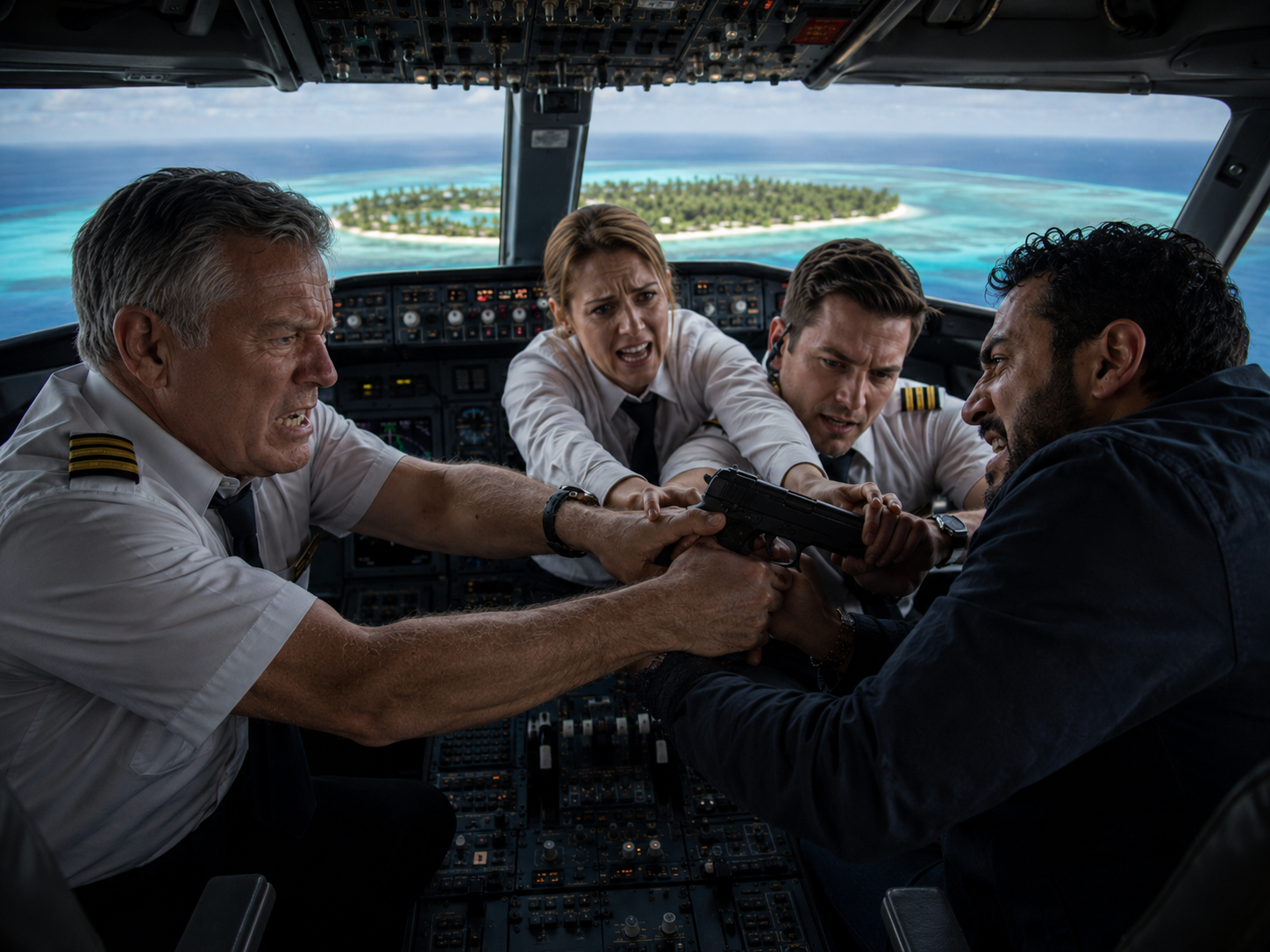
Omar shoved Lydia inside first. Mastafa followed with one hand gripping Jacob’s headset and the other raising his weapon. Sara stepped from behind the small service partition and swung a heavy emergency flashlight with both hands.
It cracked against Mastafa’s temple.
He roared and fired into the ceiling.
Jacob ducked. Lydia screamed. Seth lunged from his seat, catching Omar’s arm as Omar tried to force his way toward the controls.
For three seconds, the cockpit was a cage full of elbows, blood, alarms, and thunder.
The jet rolled left.
Passengers screamed as the ocean swung into the windows.
Bonnie slammed against Wilfred. Oxygen masks dropped like yellow spiders from the ceiling.
Seth drove Omar into the cockpit wall. Omar struck him twice in the ribs. Mastafa, bleeding from the temple, grabbed Sara by the hair and flung her into the instrument panel.
The aircraft pitched down.
Jacob, half out of his seat, fought to pull the yoke back.
“Captain!”
Seth reached over Omar’s shoulder and grabbed the throttle quadrant, but Omar clung to him, wild-eyed, snarling in a language Seth did not understand.
Sara, dazed and bleeding from one eyebrow, saw the heading spinning.
They were no longer skirting the weather.
They were entering it.
The first bolt of lightning flashed so close the cockpit went white.
Then the aircraft fell.
Not dropped. Fell.
Every loose object in the cabin lifted. A coffee cup floated. A shoe rose. A child’s toy spun in the aisle. Bonnie’s stomach seemed to stay at 34,000 feet while the rest of her body plunged toward the Pacific.
Wilfred joined a chorus of screaming.
Bonnie had her eyes on the little scissors lying three feet away in the aisle.
Mastafa stumbled out of the cockpit, blood streaming down the side of his face.
“Stay down!” he shouted.
He did not see Bonnie slide one foot forward.
The scissors disappeared beneath her shoe.
The jet bucked again, harder. Mastafa hit the overhead bin and fell to one knee. Bonnie reached down, closed her fist over the scissors, and shoved them into her sleeve.
Up front, Omar pressed his weapon against Seth’s neck.
“You fly where I say.”
Seth was breathing hard. “You picked a hell of a time for directions.”
Sara pulled herself upright. Blood ran into one eye.
“Terrain alert,” Jacob said.
Seth snapped his head toward the display. “Out here?”
Sara stared at her screen. “Island chain. Small. Not on the passenger maps.”
Lightning hit somewhere behind them. The aircraft systems flickered, died for half a heartbeat, then returned in red and amber.
An alarm shrieked.
Jacob’s voice cracked. “We’re losing hydraulics.”
Seth looked through the windshield. Nothing but gray cloud and rain.
“How far?”
Sara grabbed the panel edge, forcing her eyes to focus. “Twelve miles. Maybe less. Lagoon on the west side if the chart’s right.”
Omar jabbed the weapon harder. “No airport?”
“No airport,” Seth said. “You broke into the cockpit of an airplane over the middle of the ocean during a storm, genius.”
Omar hit him across the mouth.
Seth tasted blood and smiled. “That all?”
For the first time, Omar looked uncertain.
Seth seized that half-second.
He slammed the aircraft into a steep turn.
Omar flew sideways into the console. Jacob grabbed his arm. Sara kicked the weapon away. Lydia, crying now, still moved—she snatched it and shoved it into a storage compartment.
Seth shouted, “Brace! Tell them brace!”
Lydia grabbed the intercom with shaking hands.
“Brace! Brace! Heads down! Stay down!”
Bonnie bent forward and pulled Wilfred down by the back of his shirt.
“I don’t know how!” he yelled.
“Like you owe money!”
The clouds tore open.
The island appeared beneath them, impossibly green, ringed by white reef and black rock. Beyond it, the Pacific stretched forever, empty and shining where sunlight broke through the storm.
They were too low.
Too fast.
Seth saw the lagoon.
“Flaps?”
“Partial,” Jacob said.
“Gear?”
“No.”
“Good. We’ll belly her in.”
Sara held the back of Seth’s seat with one hand and the panel with the other. “Reef shelf on approach!”
“I see it.”
“You don’t have the angle.”
“I see it!”
In row 18, Bonnie heard Wilfred praying badly.
“Dear Lord, I know I haven’t been on a plane before, and I complain a lot—”
“Head down!” Bonnie shouted.
The jet tore through palm trees with pounding thumps and the deafening screech of twisting metal. A wing sheared through green canopy as the cabin ripped open and lurched sideways. Windows exploded inward. The aircraft struck water, bounced, struck again, and slid across the lagoon in a towering spray.
Seats tore loose. Luggage became missiles. The lights went out.
The final impact came with a grinding creak then stunning silence.
Then came water.
Cold, fast, pouring through the broken fuselage.
Bonnie opened her eyes upside down.
For a moment she could not understand why the ceiling was below her.
Then Wilfred was shouting.
“Miss Bonnie! Miss Bonnie!”
“I’m here.”
Her seatbelt jammed. Smoke stung her throat. People were screaming in darkness. She felt and tasted salt water. Wilfred fumbled with his buckle and fell sideways into the aisle. He crawled to her.
“My belt,” she said.
He pulled. Nothing.
The rising water reached her seat.
“Wilfred!”
“I’m trying!”
Bonnie shoved the little scissors into his hand.
His eyes widened. “You stole these?”
“Cut.”
Wilfred sawed at the strap with frantic clumsiness, the blades slipping, his fingers bleeding. After a minute that seemed eternal, the belt snapped. Bonnie dropped hard into the aisle, gasping for breath as smoke filled the battered cabin.
They crawled toward a crack of daylight where the fuselage had split.
Outside, rain hammered the lagoon. The front half of the jet sat at an angle in shallow water, its broken tail smoking farther back near the reef. The left wing was gone. The right wing burned near the shoreline in greasy orange flames.
Bonnie tumbled out onto wet sand and vomited seawater.
Wilfred landed beside her and kissed the beach.
“I take back everything I ever said about buses,” he groaned.
Lydia staggered from the wreck carrying a child under one arm. Sara followed with Jacob, whose left sleeve was soaked red. Seth came last from the cockpit, dragging Omar Abbas by the collar.
Omar was unconscious.
Mastafa was not.
He emerged from a torn opening near first class with blood on his face, a limp in his left leg, and a weapon in his hand.
For two seconds, everyone stared at him.
Then he fired into the air.
“Move!” he shouted. “All of you, away from the plane!”
There were nineteen survivors.
That number fell to eighteen when an older man collapsed before they reached the tree line.
The island was small, maybe two miles long, shaped like a crooked tooth, with a jungle-covered ridge rising at its center and beaches on three sides. The wreck burned behind them, sending black smoke into a sky already bruised by storm.
Mastafa forced them beneath the palms.
Omar woke there, coughing, one eye swollen.
He looked at the survivors, then at the wreck, then at Seth.
“You will fix the radio.”
Seth laughed once, humorless. “Look at it.”
Omar struck him in the stomach.
Seth doubled over but did not fall.
“You will fix the radio,” Omar repeated.
Sara spoke before Seth could. “The radio is gone. Emergency beacon might have triggered on impact.”
Omar turned to her. “Might?”
Sara wiped rain and blood from her face. “That means maybe.”
Mastafa pointed toward the smoke. “Then we wait.”
“No,” Omar said. His eyes moved over the survivors, calculating. “We make them come. Then we take what comes.”
Bonnie understood him before some of the others did.
He did not want rescue.
He wanted hostages delivered fresh.
The storm passed near dusk, leaving the island steaming and bright with insects. Mastafa divided the survivors into groups. The injured were laid beneath palms. The rest were forced to haul supplies from the wreck: flotation cushions, water bottles, food carts, first aid kits, a flare case Mastafa kept for himself.
Bonnie moved among the injured with Lydia and a retired Navy medic named Grace Parnell, tying cuts, calming panic, making lies sound like medicine.
“You’re all right.”
“Help is coming.”
“Don’t look at the bone.”
Wilfred followed her like a nervous dog.
“I should help,” he said. “I’m good with shelving. I used to manage a warehouse.”
“Then manage those water bottles,” Bonnie said.
He nodded gratefully and hurried off.
Near the tree line, Sara crouched beside Seth and Jacob.
“They didn’t find the portable beacon,” she whispered.
Seth looked at her.
“I had it clipped behind the nav case,” she said. “It came loose during the crash. I saw it under the cockpit panel before Mastafa dragged us out.”
Jacob held his injured arm against his chest. “Can we reach it?”
“Not in daylight,” Seth said.
Bonnie appeared beside them with bandages. “Reach what?”
Seth studied her a moment. Then he looked at her sleeve, where the little scissors had left a dark metal outline.
“You’re braver than you look,” he said.
Bonnie began wrapping Jacob’s arm. “No, Captain. I’m angrier than I look.”
Seth almost smiled.
Night came fast.
The island changed with it. The surf grew louder. The jungle clicked and hissed. The wreck glowed like a dying furnace on the beach. Omar sat with his back against a palm, weapon across his knees, talking to Mastafa in a low voice.
Bonnie pretended to sleep.
So did Wilfred, badly.
“You awake?” he whispered.
“No.”
“I don’t think I’m cut out for flying.”
“Wilfred.”
“Yes?”
“When I move, you roll toward Lydia and make noise.”
“What kind of noise?”
“I don’t care. Big noise.”
He stared at her. “Are we doing something brave?”
“No. We’re doing something stupid, and hope it looks brave later.”
That seemed to comfort him.
Near midnight, Sara rose first.
She moved like smoke through sleeping bodies. Seth followed. Bonnie waited three breaths, then kicked Wilfred lightly.
He rolled over, flailed, and shouted, “Crab! Crab on my neck!”
Every survivor jolted.
Mastafa sprang to his feet and charged toward him.
Bonnie slid behind a palm as Sara and Seth slipped toward the wreck.
Wilfred slapped at himself. “It had claws! I swear it was bigger than a pony!”
Mastafa grabbed him by the shirt and hauled him upright.
“You think this is funny?”
Wilfred shook his head violently. “No, sir. Giant crabs are not funny - they’re scary.”
Bonnie had to bite the inside of her cheek.
At the wreck, Sara climbed through the torn cockpit window. Seth stood below, watching the beach.
Inside, the cockpit stank of smoke, saltwater, burned electronics, and blood. Sara crawled under the tilted instrument panel, feeling blindly. Her fingers closed around fabric, wiring, glass.
Then hard plastic.
The beacon.
She pulled it free.
A hand clamped around her ankle.
Omar.
He had followed them barefoot through the surf.
Sara kicked. Omar dragged her halfway out of the cockpit. Seth lunged, but Omar slashed at him with a piece of jagged metal. Seth staggered back, bleeding across the forearm.
Sara twisted and drove her heel into Omar’s face.
He lost his grip.
The beacon flew from her hand and skidded across the wet sand.
Omar went after it.
So did Seth.
From the trees, Mastafa heard the struggle and turned.
Bonnie saw everything happen at once. Mastafa raising his weapon. Wilfred standing frozen. Lydia pulling the child behind her. Jacob, injured and pale, reaching for a length of driftwood.
Bonnie ran.
She did not think. Thinking belonged to people with time.
She hit Mastafa from the side with her shoulder, all one hundred and thirty pounds of her driven by terror, grief, fury, and every man who had ever underestimated a woman holding scissors.
The shot went wild.
Mastafa backhanded her so hard she nearly passed out.
Wilfred made a sound she had never heard from him before—not fear, not panic, but rage.
He tackled Mastafa around the knees.
Both men crashed into the sand.
The weapon spun away.
Jacob got there first and kicked it into the lagoon.
Mastafa cursed in his language and drove an elbow into Wilfred’s face. Wilfred held on.
“Not this time!” he shouted, though no one knew what other time he meant.
Bonnie crawled toward them, blood in her mouth. Mastafa reached for her throat.
She drove the little scissors into his forearm.
He howled.
Grace Parnell, the retired medic, came out of nowhere swinging a fire extinguisher from the wreck. The steel cylinder struck Mastafa hard behind the ear and he dropped.
On the beach, Seth and Omar rolled through the surf, fighting over the beacon. Omar was younger, stronger, desperate. Seth was older, hurt, but equally desperate.
Omar got one hand around Seth’s throat.
Sara picked up a stone and hit Omar in the shoulder. He turned, snarling.
That was enough.
Seth drove his knee up and rolled him into the shallows. Jacob stumbled in, grabbed Omar from behind, and helped Seth force him face-down into the sand.
The fight ended in wet, bloody exhaustion.
The survivors tied Omar and Mastafa with torn seatbelt straps. Mastafa cursed in his language until Grace told him she would gag him with a sock if he did not quiet down.
He believed her.
Sara activated the beacon.
A small red light began to blink.
No one cheered.
They were too tired for hope to arrive all at once.
It came slowly, like dawn.
By morning, the storm had cleared, and the Pacific lay blue and endless around them. The wreck smoked less. The wounded slept, some moaned intermittently. Lydia sat holding the little girl whose mother had not made it. Jacob leaned against a palm, feverish but alive. Seth stood at the waterline, one arm bandaged, staring at the horizon as if daring it to remain empty.
Bonnie sat beside Wilfred. His nose was swollen. One eye was closing. Sand stuck to his hair.
“You look terrible,” she said.
He touched his bruised face carefully. “Do you think it’ll scar?”
“Maybe a little. Scars can be interesting.”
“Good,” he said. “I never had an interesting face.”
Bonnie laughed, then found herself crying.
Wilfred looked alarmed. “Did I say something wrong?”
“No,” she said. “You said exactly right.”
Near noon, Sara heard it first.
A distant thump.
Then another.
Everyone turned toward the sky.
The helicopter appeared as a black speck over the southern reef, then grew larger, louder, real. Behind it came a second aircraft, circling high.
Lydia raised both arms.
Jacob sank to his knees.
Seth closed his eyes.
Bonnie stood slowly, one hand over her mouth. Wilfred rose slowly, wobbled, then stood beside her.
The helicopter swept over the beach, sand blasting outward, palm fronds thrashing. A rescue swimmer dropped down, then another. Voices shouted. Hands reached. Medical bags opened. Omar and Mastafa were taken first—not gently, handcuffed but alive.
When it was Bonnie’s turn, she looked back at the island.
The beach was scarred with wreckage. Palm trees lay snapped and broken. The shattered jet still smouldered. The terrorists had left it an ugly little place, savage and hot and full of ghosts.
But eighteen people were leaving it.
That counted for something.
Wilfred climbed into the helicopter behind Bonnie and immediately grabbed the bench with both hands.
Bonnie leaned close. “Still afraid of flying?”
He looked out at the wrecked aircraft, the handcuffed terrorists, a gun pointed at them, the impossible ocean, and the blinking beacon still flashing red in Sara Fisk’s hand.
Then he looked at Bonnie.
“Ma’am,” he said, “after this, I believe I’m more afraid of landing.”
Bonnie laughed so hard the rescue medic thought she was in shock.
Maybe she was.
Above them, Captain Seth Ferman sat near the open door, watching the island fall away. Jacob Johnson was strapped beside him, pale but grinning. Sara Fisk held the beacon in her lap like a trophy. Lydia Chen held the orphaned child, whispering something soft into her hair.
The helicopter lifted into clean Pacific sunlight.
No one spoke for a long time.
There was no need.
Eighteen bruised people sitting shoulder to shoulder, held together by bandages, seatbelts, bad jokes, and a stubborn refusal to succumb.
Far below, the deserted island shrank into the sea.
Ahead, the rescue ship waited.
And for the first time since Flight 417 left the sky, Bonnie Graves allowed herself to believe they were going home.