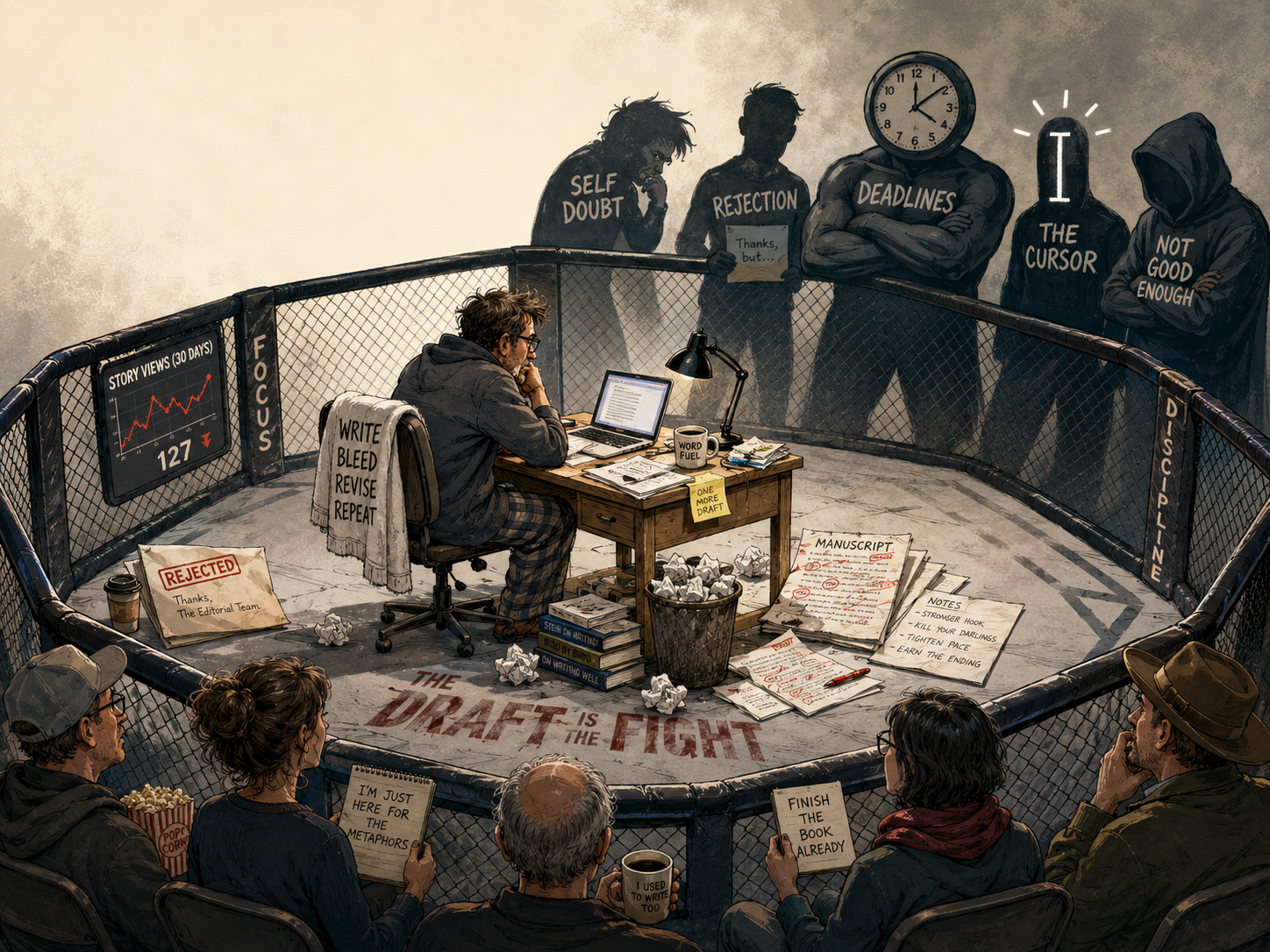
Creative writing is a little like cage fighting before an audience of five. Actually, cage fighting might provide more immediate satisfaction. At least there would be a live crowd and an occasional cheer. Writers, after several rounds of circling their own doubts, might only land a punch on their inner critic.
The creative writer often bleeds invisibly. The wounds are made of commas, invoices, unanswered emails, and the sentence that looked brilliant at midnight but, by breakfast, resembles something written by a loopy cage fighter with a thesaurus. The writer sits alone in a room, staring at a blank page with the intensity of a prizefighter studying an opponent. Unfortunately for writers, the opponent is also the referee, the promoter, the heckler, and the one responsible for remembering whether the electric bill has been paid.
Like an aging, battered cage fighter, the experienced but ever-unheralded creative writer knows a great deal about fancy footwork. We bob and weave around self-doubt. We duck too late from the fist of rejection. We feint confidence, then retreat to the kitchen for coffee. We spend hours, days, and, if we are foolish enough to keep going, years creating stories, columns, poems, essays, novels, and fragments of novels that remain one step outside the publishing house, which is our performance cage. We train for a bout that may never be scheduled, in an arena that may never open its doors, before judges who may never read beyond page three.
There is, of course, a romantic image of the writer: a sensitive soul at a desk by a window, bathed in golden light, effortlessly channeling wisdom into sentences while a mug of coffee goes cold. This is a deceptive image: it leaves out the unpaid labor, the stiff neck, the browser tabs titled “synonyms for sad but not too sad,” and the fact that you haven’t been to the gym in weeks. The average creative writer does not exist inside such a candlelit portrait of genius. The average creative writer is more likely wearing a tee shirt, muttering at a paragraph, and wondering whether “evocative” is a beautiful word or evidence of moral decadence.
This is where the comparison to cage fighting becomes useful. Both fighters and writers sign up, voluntarily, for a contest that sensible people might avoid. Both must accept pain as part of the craft. Both rely on stamina, timing, discipline, and a private tolerance for humiliation. The fighter misses a kick and hits the mat. The writer submits a piece and receives a notice of rejection that could have been printed on a fortune cookie. The fighter has bruises. The writer has track and plot changes. The fighter hears a bell. The writer hears a notification and for a moment believes destiny has arrived, only to discover a coupon for printer ink.
The first opponent is self-doubt, a wiry little creature with excellent reach. It appears before the writing even begins. “Hasn’t this been said before?” it asks. “Who are you to write about this?” Then, just as the writer starts to answer, it follows with a jab: “Also, your opening line is weak.” Self-doubt is not always wrong, which is what makes it so dangerous. Occasionally it points out a real flaw. More often, it impersonates wisdom while trying to stop the fight before the first round. It tells the writer that originality is impossible, that the world already has enough books, that every idea has been done, and that the only honorable response is to mow the yard.
Then comes comparison, self-doubt’s glamorous cousin. Comparison arrives wearing a velvet jacket holding a glass of champagne in one hand and a bestseller list in the other. It points to celebrated authors, viral essayists, prize winners, and people on the internet who pump out flawless prose between yoga and breakfast. The average writer, who has spent forty minutes deciding whether a character should “walk” or “stride,” looks at these people and concludes that everyone else was issued a secret manual. The truth is less elegant. The best writers stumble into the cage that is creative writing; we only see one another’s polished performances. We do not see the deleted drafts, the unpaid bills, or the moment when someone considered naming a character “Brad” because creativity is temporarily face down on the mat.
Writer’s block is another opponent, and it has the psychological subtlety of a concrete wall. Some writers say it doesn’t exist. They imagine writer’s block as creative laziness. They picture the writer doddering, sharpening pencils, or having some ice cream while refusing to write until inspiration descends. But for some, writer’s block is both real and maddening. It is wanting to write and finding no words. It is having words, but hating them. It is knowing the scene, but not the door into it. It is facing the blank page as if it were a cage door closing behind you while the announcer says, “In this corner, weighing absolutely nothing and yet somehow crushing your spirit, the cursor.”
Creativity is wonderful, but woefully unreliable. It does not keep office hours. It arrives in the shower, in traffic, and even when you are at the Department of Motor Vehicles having your picture taken. It vanishes the moment you get home and open the laptop. Creative writers function as the artist, editor, marketer, accountant, motivational speaker, and occasionally a human being. Like most people, they have jobs, families, errands, aches, obligations, griefs, and must partake in the ordinary maintenance of life. The glamorous writing retreat, for many average writers, is a stolen twenty-seven minutes after dinner while the laundry buzzes and the dog barks at the UPS driver.
Time is the opponent that does not punch; it simply leans on you. Time is the supernatural boss that says if you truly cared you would rise at five, write before work, revise during lunch, submit after dinner, build a platform before bed, and dream in publishable paragraphs. Some discipline is necessary, but discipline is not magic. A writer can love the craft and still need rest. The myth that real writers are always writing is one of the crueler myths, right up there with “exposure is good payment” and “this will be easy because it’s only 800 words.”
Then there is payment. Here the cage lights flicker and the crowd goes quiet. The average creative writer may spend long hours drafting, revising, submitting, promoting, networking, reading guidelines, formatting manuscripts, all while receiving little or no pay. This is a serious wound wrapped in comic bandages. When the person who creates the story asks to be paid, the room suddenly discovers the nobility of art for art’s sake. Low pay can turn a writer into a contortionist. One must believe in the work deeply enough to continue, but not so deeply that bills pile up. We treat writing as serious labor, even when the marketplace treats it as a charming hobby with occasional coffee money. Traditional publishing can feel like trying to enter a locked gym through a keyhole. Self-publishing can feel like renting the gym, selling the tickets, designing the poster, fighting the bout, mopping the floor, and then being told you also need a newsletter strategy. Freelance opportunities may pay, but not always enough, and sometimes the most enthusiastic clients are enthusiastic precisely because they do not intend to pay much.
Retirement adds a peculiar twist to this bout. The retired writer may no longer be writing for rent, groceries, or the faint hope of turning a paragraph into a utility payment. Money, at least in theory, is not the object. This sounds liberating until the writer discovers that passion has developed its own accounting department. Instead of checks, there are page views. Instead of royalties, there is a tiny graph on Google Analytics rising or falling like a cardiogram for the ego. The retired writer tells himself he is above all that, then refreshes the numbers with the concentration of a corner man checking pulse and blood pressure between rounds. No one is paying him, which should make him free. Somehow, it only means the applause has been converted into data.
Rejection is the sport’s official soundtrack. It comes in many forms: the polite no, the silent no, the no disguised as “not quite right for us,” and the especially athletic no that arrives eleven months later, after the writer has forgotten submitting and briefly believes the email concerns a medical test. Rejection hurts because writing is intimate work. Even when the writer knows, intellectually, that a rejected piece is not a rejected soul, the body still reacts as if the editor has stepped into the cage and performed a flying knee to the confidence.
Criticism, when thoughtful, can be a trainer. It points out the dropped guard, the weak stance, the lazy sentence. A good editor can save a writer from self-indulgence, but criticism can also feel like a chair was thrown from the stands. The writer must learn the difficult art of listening without surrendering the whole self. Keep the useful notes. Leave the rest on the mat.
Then there is the matter of being taken seriously. The average creative writer may have people in life who nod kindly at the word “writing” in the same tone used for model trains, amateur bird calls, or a suspicious new diet. “That’s nice,” they say. “But what do you really do?” The answer, usually, is several things. The writer works, cooks, drives, worries, pays, waits, edits, reads, revises, and then writes because something in the mind refuses to remain quiet. Writers, particularly creative ones, keep returning to the page after being ignored, underpaid, overextended, and taken to the mat by the craft.
And yet, somehow, there are rewards. Perhaps not fame or wealth unless one counts the emotional fortune of finding a perfect verb after three days of linguistic poverty. Mostly, the rewards are quiet and personal. A paragraph finally lands. A reader, maybe only one, writes to say that a line stayed with them. A draft becomes less awful. A column makes somebody laugh and then, inconveniently, think.
Writers train their attention the way a cage fighter trains the body to survive impact. The writer trains the mind to survive ambiguity, memory, boredom, longing, contradiction, and the suspicion that the second draft still stinks. Humility is a necessary requirement for getting up. A fighter’s comeback is visible: the crowd sees the stumble, the rise, the swing. A writer’s comeback may be nothing more dramatic than editing a paragraph.
To me, writers are just stubborn people with notebooks. But there is dignity in stubbornness when the work is honest. There is courage in creating something without guarantees. A writer might spend a Saturday rearranging a paragraph that will earn nothing and impress few and feel they won that round.
Writers risk caring deeply about something that may not care back. But struggle does not make someone less of a writer. The trick is not to romanticize suffering, because suffering is an overrated editor. Instead, recognize the struggle, laugh at its more ridiculous disguises, and train hard for each bout.
When we step back into the cage, the crowd may be small and the purse insulting and the opponent may look suspiciously like yesterday’s insecurity wearing fresh gloves. Still, the writer circles, breathes, and lands one sentence. Then another. A dodge. A jab. A revision. A joke that hides a bruise. Your five-person audience might laugh, applaud, or maybe even understand. And for the battered, hopeful, unpaid, overcaffeinated creative writer, that may be enough to answer the bell one more time.
2 Likes ∙ 1 Restack